

Imagine you’re flying high above the clouds.
You look out of the airplane window and see fluffy white clouds floating below.
Everything looks beautiful…
Until you notice something strange.
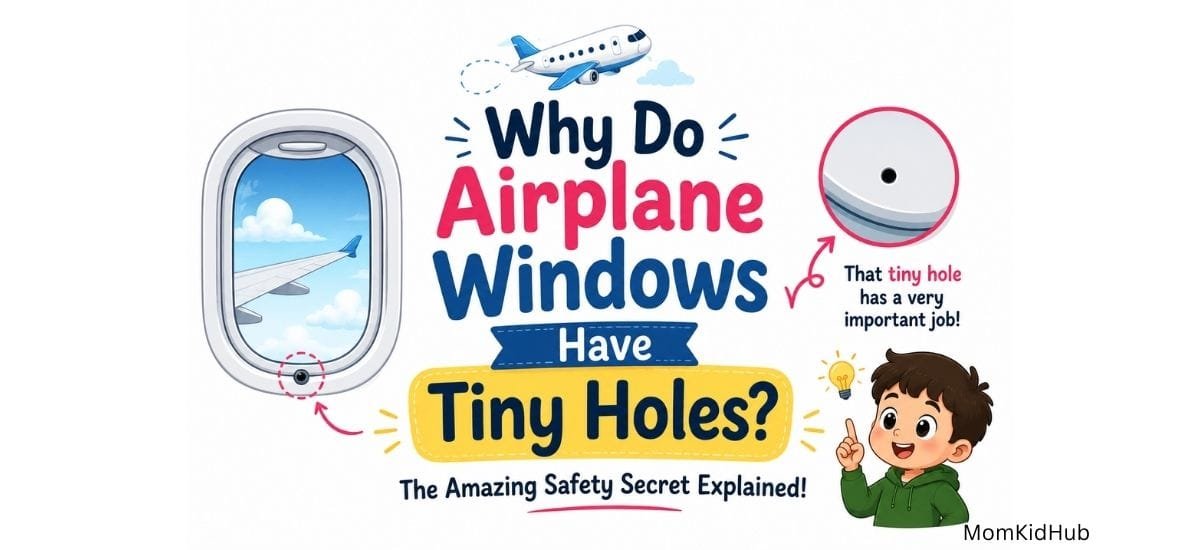
There’s a tiny hole in the window!
Your first thought might be…
“Is the window broken?”
Or…
“Should an airplane really have a hole in its window?”
Don’t worry!
That tiny hole is supposed to be there, and it has a very important job.
Let’s find out why.
An airplane window isn’t made from just one piece of glass.
In fact, it’s made of three strong layers.
Each layer has a different job to do.
The tiny hole is only found in the inside layer, not the outside one.
Pretty clever, right?
But…
Why is it there?
To understand the tiny hole, imagine blowing up a balloon.
As you blow air into it, the air inside pushes against the balloon.
The more air inside, the more pressure it creates.
An airplane works in a similar way.
When a plane flies at 35,000 feet, the air outside is much thinner than the comfortable air inside the cabin.
This creates a big difference in air pressure.
Without strong windows, flying would not be safe.
The tiny hole is called a bleed hole (or breather hole).
Its job is to let the air pressure between the window layers stay balanced.
This clever design makes sure that almost all of the pressure is carried by the strong outer window, instead of being shared by all three layers.
That makes the window even safer and stronger.
The tiny hole doesn’t only help with air pressure.
It also helps stop the window from fogging up.
Have you ever noticed your house window becoming foggy on a cold day?
That’s because warm and cool air meet.
The tiny hole helps reduce moisture between the window layers, giving passengers a much clearer view of the sky.
Absolutely!
Airplane windows go through very strict safety testing before they are ever used.
They are built to handle huge differences in air pressure and extreme temperatures.
The tiny hole is actually one of the reasons airplane windows work so well.
✈️ Airplanes usually fly around 35,000 feet above the ground.
☁️ The air outside is much colder and thinner than the air inside the cabin.
🪟 Airplane windows have three layers, not one.
💨 The tiny hole is called a bleed hole.
🌍 Millions of people safely fly around the world every day.
The tiny hole is only about the size of a pinhead.
Even though it’s so small, it plays a big role in making every flight safer.
Sometimes, the smallest parts have the biggest jobs!
A. One
B. Two
C. Three
✅ Answer: Three
A. Air hole
B. Bleed hole
C. Safety hole
✅ Answer: Bleed hole
The tiny hole means the airplane window is broken.
❌ False
It is an important safety feature designed by engineers.
The next time you fly on an airplane, take a closer look at the window beside your seat.
If you notice a tiny hole…
You’ll know it’s not a mistake.
It’s a clever little design that helps balance air pressure, reduces fogging, and makes flying even safer.
Nature is amazing…
But sometimes, engineering is pretty amazing too! ✈️💙
If you enjoyed this mystery, you might also love:
🪱 Why Do Earthworms Come Out After It Rains?
🌊 Why Are Oceans Salty but Rivers Aren’t?
🦎 Why Can Lizards Walk on Walls?
🦜 Why Can Parrots Copy Our Words?
✏️ The Amazing Story of the Pencil for Kids
🐢 The Rabbit and the Tortoise Story for Kids