


Have you ever wondered who invented the pencil?
Every day, children use pencils to write stories, solve math problems, draw pictures, and learn new things. But the pencil wasn’t always around.
In fact, people lived for thousands of years without pencils!
Let’s travel back in time and discover the amazing story behind one of the world’s most important inventions.
Before pencils were invented, people used many different tools for writing.
Some wrote with:
These tools worked, but they were often messy and difficult to carry.
Mistakes were also hard to fix.
People needed a better way to write.
Around the year 1564, people in England discovered a strange black material underground.
This material was called graphite.
At first, people thought it was a type of lead.
Today we know that graphite is completely different from lead.
People quickly noticed that graphite left dark marks on paper.
It was perfect for writing and drawing.
This discovery would eventually lead to the invention of the pencil.
The earliest pencils did not look like today’s pencils.
People simply held pieces of graphite and used them to write.
There was one problem.
Their fingers became black and messy!
To solve this, people wrapped graphite sticks in cloth, leather, or string.
It worked, but there was still room for improvement.
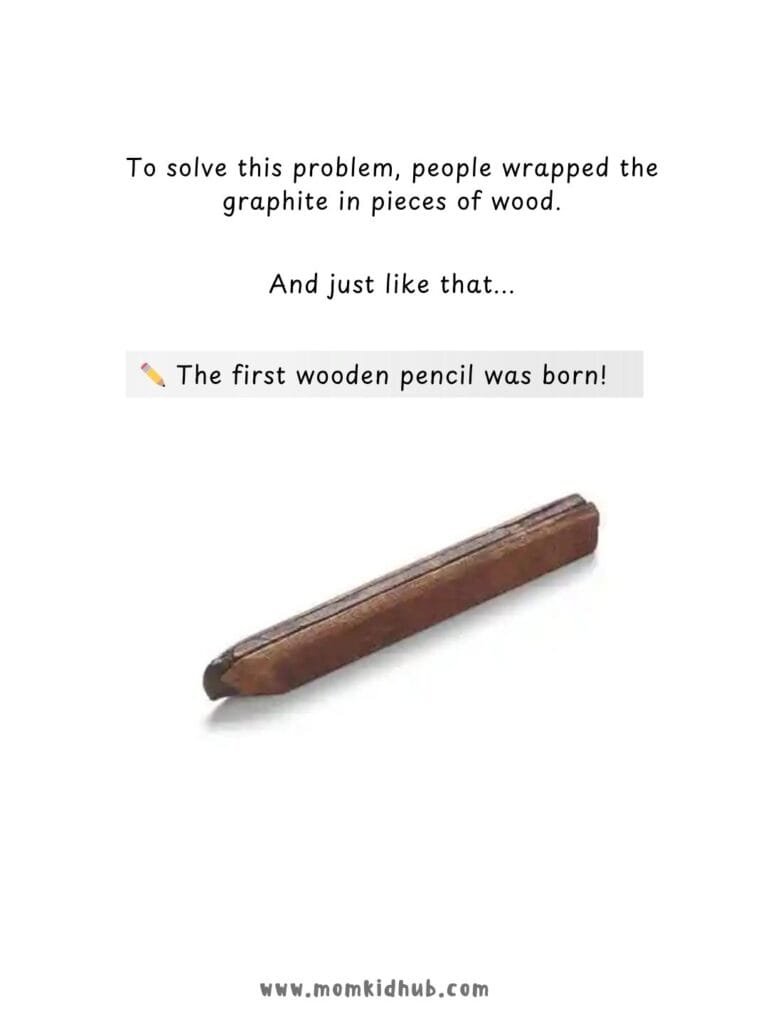
Someone had a clever idea.
Why not place the graphite inside wood?
Craftsmen carved grooves into wooden pieces, inserted graphite, and glued another piece of wood on top.
This simple invention created the first wooden pencil.
The design was so successful that we still use it today.
For many years, pencils did not have erasers.
If people made mistakes, they had to cross them out or start again.
In 1858, an inventor attached an eraser to the end of a pencil.
This made writing much easier and more convenient.
Today, many pencils still include an eraser.
Many children think pencils contain lead.
They don’t.
The writing core inside a pencil is made from:
Different amounts of graphite and clay create different pencil grades.
For example:
Artists often use softer pencils, while students usually use HB pencils.
Modern factories produce billions of pencils every year.
The process is fascinating.
Graphite and clay are mixed together.
The mixture is shaped into long thin rods.
Wooden slats are prepared with grooves.
The graphite rods are placed inside the grooves.
Another wooden slat is glued on top.
The pencils are cut, painted, polished, and packaged.
That’s enough to fill many pages of a book.
That’s longer than many city journeys.
Despite the nickname “pencil lead,” pencils actually contain graphite.
That’s a huge number of pencils!
Yellow was once used to show that a pencil contained high-quality graphite.
Pencils do much more than help children write.
They also help children:
Even in a digital world, pencils remain one of the most important learning tools.
A. Lead
B. Graphite
C. Ink
A. India
B. England
C. China
A. To make it colorful
B. To stop hands from getting messy
C. To make it heavier
The pencil may seem simple, but it has an amazing story.
From the discovery of graphite hundreds of years ago to the billions of pencils made today, this invention has helped people learn, create, and share ideas around the world.
The next time you pick up a pencil, remember that you’re holding one of the most important inventions in history.
And perhaps your next great idea will begin with it.