

India is a land of rich culture, colorful traditions, incredible wildlife, and a fascinating history. Every country has special symbols that represent its identity, values, and heritage. These are called national symbols.
From the Indian National Flag (Tiranga) to the majestic Royal Bengal Tiger, every national symbol tells an important story about India. Learning about these symbols helps children understand the country’s culture, respect its traditions, and feel proud to be a part of India.
Whether you’re a parent, teacher, or student, this guide explains the National Symbols of India for kids in a simple and engaging way.
🎁 Bonus: At the end of this article, you can download our FREE National Symbols of India Coloring Pages PDF to make learning even more fun!
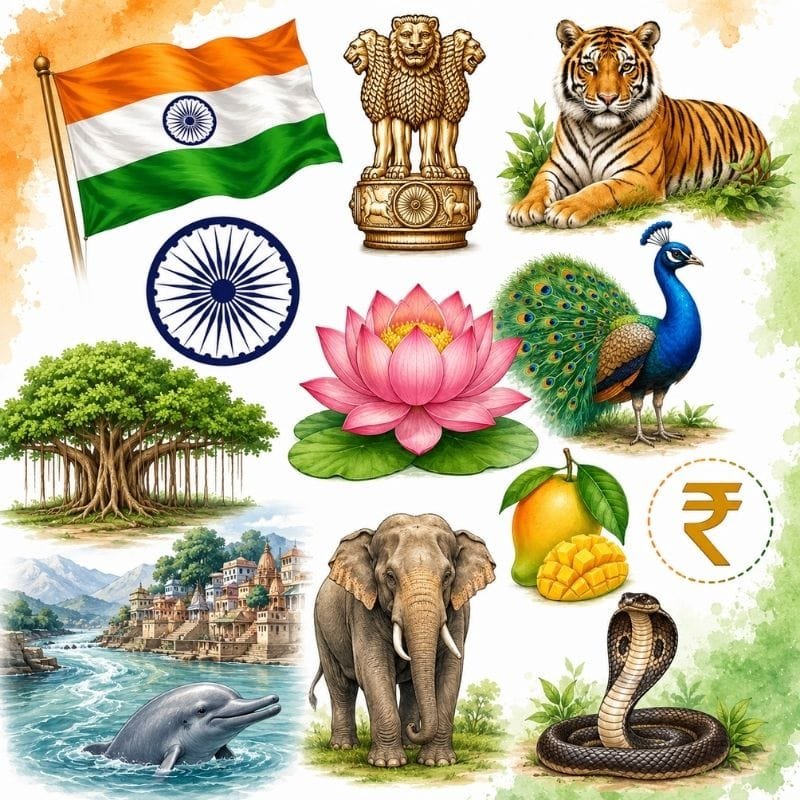
National symbols are special objects, animals, plants, songs, and emblems that represent a country. They remind people of their nation’s history, culture, traditions, and values.
Every country has its own national symbols, and India has several official symbols that make our country unique.
Children often see these symbols during:
Learning about these symbols helps children connect with India’s rich heritage while developing respect and love for their country.
National symbols are more than just pictures or objects. They tell the story of our country and bring people together.
They help children:
✅ Learn about India’s history
✅ Understand different cultures and traditions
✅ Respect nature and wildlife
✅ Feel proud of their country
✅ Develop a sense of unity and responsibility
These symbols remind us that although India has many languages, cultures, and traditions, we are all part of one nation.
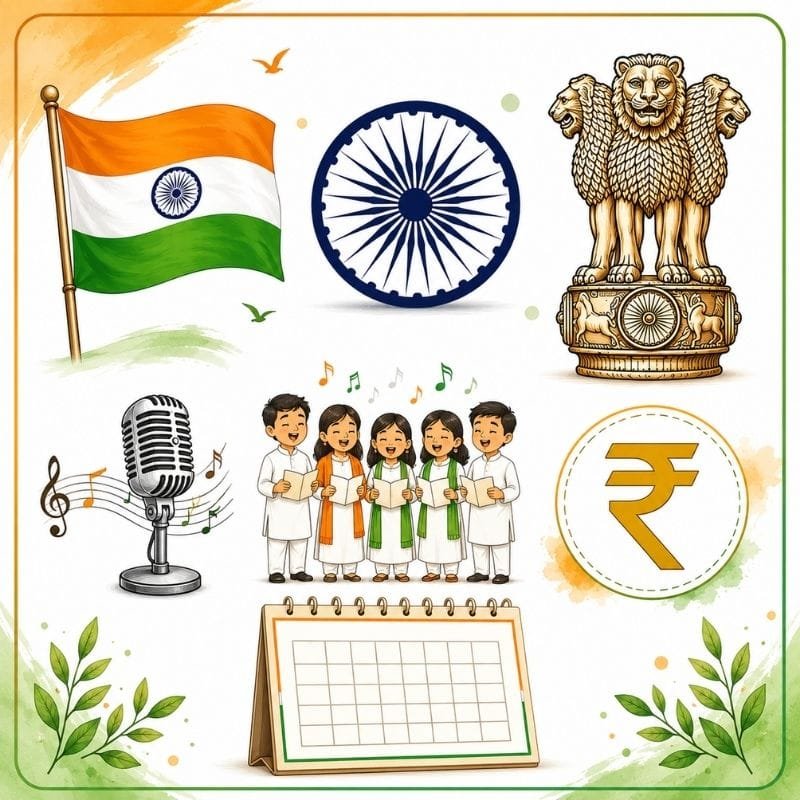
India has several official national symbols that represent its identity, culture, wildlife, and heritage. Let’s learn about each one.
The National Flag of India, also called the Tiranga, is one of the most important symbols of our country.
It has three horizontal stripes:
In the center of the white stripe is the Ashoka Chakra, a blue wheel with 24 spokes.
The Ashoka Chakra reminds us to always move forward with honesty, hard work, and justice.
The Indian National Flag should always be treated with respect and dignity.
The Ashoka Chakra is the blue wheel found at the center of the Indian National Flag.
It has 24 equally spaced spokes and represents progress, justice, and continuous movement.
The wheel reminds us that life should always move forward with honesty and good values.
The Ashoka Chakra replaced the spinning wheel (Charkha) in the National Flag before India became independent.
The National Emblem of India is adapted from the famous Lion Capital of Ashoka at Sarnath.
The emblem shows four Asiatic lions standing back-to-back. From the front, only three lions are visible.
Below the lions are a horse, a bull, and the Ashoka Chakra.
The words “Satyameva Jayate” appear below the emblem. These words mean:
“Truth Alone Triumphs.”
The National Emblem reminds us to always speak the truth and do the right thing.
You can see the National Emblem on Indian passports, coins, currency notes, and government buildings.
India’s National Anthem is “Jana Gana Mana.”
It was written by Rabindranath Tagore.
The anthem celebrates the unity and diversity of India and is sung during national events, school assemblies, and important ceremonies.
Whenever the National Anthem is played, everyone stands respectfully to show love and respect for the country.
Standing quietly during the National Anthem is a way of showing respect to the nation.
“Vande Mataram” is India’s National Song.
It was written by Bankim Chandra Chattopadhyay in his novel Anandamath.
The words “Vande Mataram” mean “I bow to thee, Mother.” The song praises India as a loving motherland and inspired many freedom fighters during India’s struggle for independence.
India’s official national calendar is the Saka Calendar.
It is used by the Government of India along with the Gregorian Calendar for official purposes.
The Saka Calendar is based on ancient Indian astronomy and begins with the month of Chaitra.
The symbol ₹ represents the Indian Rupee, India’s official currency.
The design combines the Devanagari letter “र” (Ra) and the Roman letter “R”, representing both India’s rich traditions and its modern identity.
Today, the ₹ symbol is recognized around the world.
The ₹ symbol was designed by D. Udaya Kumar, an Indian designer.
Now that you’ve learned about India’s national identity symbols, let’s explore India’s amazing wildlife, plants, rivers, and natural treasures—including the Royal Bengal Tiger, Peacock, Lotus, Banyan Tree, Mango, Ganga, Ganges River Dolphin, Indian Elephant, and King Cobra—in the next section. We’ll also share fun facts and a FREE printable National Symbols of India Coloring Pages PDF that your kids can enjoy at home or in the classroom.
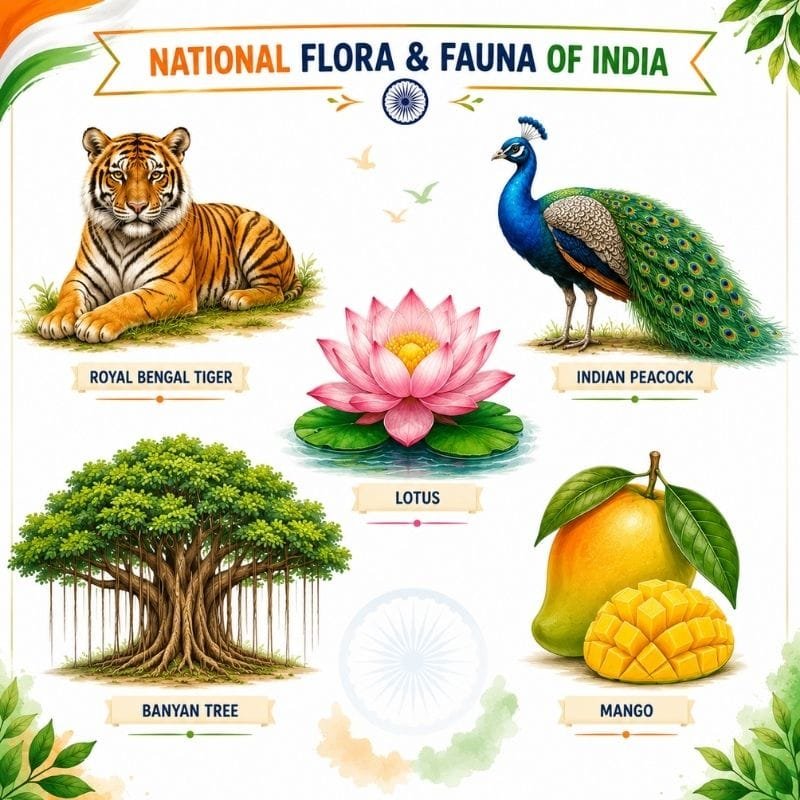
India is home to incredible animals, birds, flowers, trees, rivers, and forests. Some of these have been chosen as official national symbols because they represent India’s natural beauty, rich biodiversity, and cultural heritage.
Let’s explore them one by one!
The Royal Bengal Tiger is the National Animal of India. It was chosen because it represents strength, courage, confidence, and grace.
Bengal Tigers live in forests, grasslands, and mangrove forests across India. They are powerful hunters and play an important role in keeping the forest ecosystem healthy.
Today, tigers are a protected species, and many national parks and wildlife sanctuaries work to conserve them.
A tiger’s stripes are unique—just like human fingerprints! No two tigers have the same stripe pattern.
The Indian Peacock is India’s National Bird. It is famous for its beautiful blue feathers and colorful tail.
During the rainy season, peacocks spread their feathers and perform a graceful dance. This beautiful display has made the peacock a symbol of beauty, pride, and joy.
Peacocks are also featured in many Indian stories, paintings, temples, and festivals.
Only the male peacock has the long, colorful tail. The female is called a peahen and has brown feathers.
The Lotus is the National Flower of India.
It grows in ponds and lakes, yet its flowers bloom clean and beautiful above the water. Because of this, the lotus is a symbol of purity, hope, strength, and new beginnings.
The lotus has been an important part of Indian culture, art, and traditions for thousands of years.
Even though the lotus grows in muddy water, its petals stay clean. That’s why it symbolizes rising above difficulties.
The Banyan Tree is the National Tree of India.
It is one of the largest and longest-living trees in the world. Its branches grow downward into the ground, forming new trunks called aerial roots.
The banyan tree provides shade and shelter to birds, animals, and people. It symbolizes strength, unity, and long life.
Some banyan trees are so large that they look like an entire forest instead of a single tree!
The Mango is India’s National Fruit and is lovingly called the King of Fruits.
India grows hundreds of varieties of mangoes, each with its own unique taste, color, and aroma. Mangoes are rich in vitamins and are enjoyed by children and adults alike.
India is one of the largest producers of mangoes in the world.
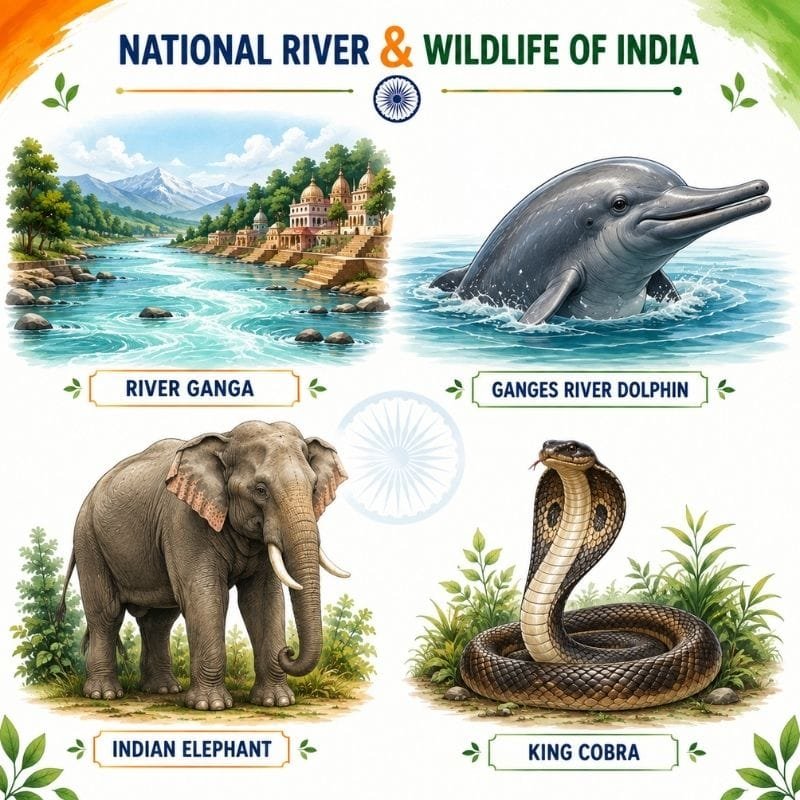
The Ganga, also known as the Ganges, is the National River of India.
It is one of the longest and most important rivers in the country. Millions of people depend on the Ganga for drinking water, farming, fishing, and transportation.
The river is also considered sacred and plays an important role in Indian culture and festivals.
The Ganga begins its journey in the Himalayas and flows into the Bay of Bengal.
The Ganges River Dolphin is India’s National Aquatic Animal.
Unlike ocean dolphins, this dolphin lives in freshwater rivers. It has a long snout and uses sound waves to find food because it has very poor eyesight.
The Ganges River Dolphin is a symbol of healthy rivers and reminds us why it is important to keep our rivers clean.
The Ganges River Dolphin is often called the “blind dolphin” because it uses echolocation instead of relying on its eyesight.
The Indian Elephant is India’s National Heritage Animal.
Elephants have been part of India’s history, culture, and forests for centuries. They are known for their intelligence, strong family bonds, and gentle nature.
Declaring the elephant as the National Heritage Animal highlights the importance of protecting wildlife and conserving forests.
Elephants can recognize themselves in a mirror and remember places and people for many years.
The King Cobra is the National Reptile of India.
It is the world’s longest venomous snake and plays an important role in nature by helping control the population of rodents and other snakes.
Although it is powerful, the King Cobra usually avoids humans unless it feels threatened.
The King Cobra is the only snake in the world that builds a nest for its eggs.
Many of India’s national symbols are living plants and animals. They are an important part of our environment and need our care.
Children can help protect them by:
Every small action helps protect India’s natural heritage for future generations.
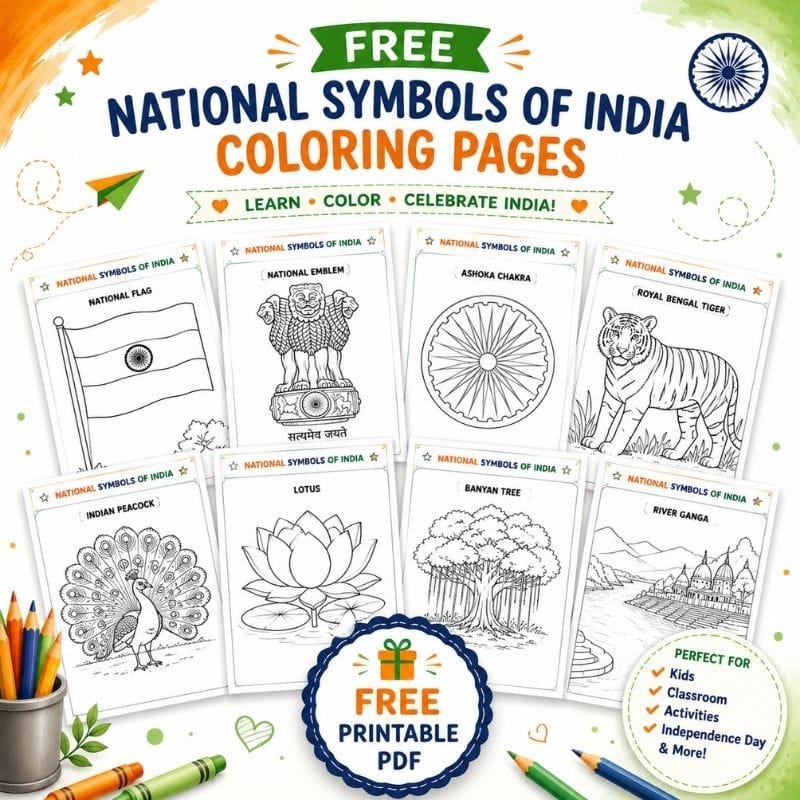
Make learning about India’s national symbols fun with our FREE printable coloring pages! Perfect for Independence Day, Republic Day, classrooms, homeschooling, and creative learning at home.
The bundle includes beautiful coloring pages of the National Flag, Ashoka Chakra, National Emblem, Royal Bengal Tiger, Indian Peacock, Lotus, Banyan Tree, Mango, River Ganga, Ganges River Dolphin, Indian Elephant, King Cobra, Indian Rupee Symbol, India Gate, Soldier Saluting the National Flag, Children Holding the Indian Flag, I Love India, and more.
👇 Click the button below to download your FREE printable PDF.
[Download FREE National Symbols of India Coloring Pages]
Let’s see how much you’ve learned!
A) Lion
B) Elephant
C) Royal Bengal Tiger ✅
D) Leopard
A) Sparrow
B) Peacock ✅
C) Parrot
D) Eagle
A) Rose
B) Sunflower
C) Lotus ✅
D) Lily
A) Banana
B) Apple
C) Mango ✅
D) Orange
A) Neem
B) Banyan Tree ✅
C) Coconut Tree
D) Mango Tree
A) 12
B) 18
C) 20
D) 24 ✅
A) Yamuna
B) Godavari
C) Ganga ✅
D) Narmada
A) Swimming
B) Running fast
C) Colorful feathers and dancing ✅
D) Flying high
A) Camel
B) Indian Elephant ✅
C) Rhinoceros
D) Horse
A) Python
B) Crocodile
C) King Cobra ✅
D) Monitor Lizard
Here are some simple ways to help children remember India’s national symbols:
Print the free coloring pages and let children color each symbol.
Show a picture and ask children to name the symbol.
Ask children to choose one national symbol and share one interesting fact about it.
Match each national symbol with its correct name.
Print two sets of picture cards and play a matching game.
Encourage children to draw and color their favorite national symbol.
National symbols are official symbols that represent India’s identity, culture, history, wildlife, and values. Examples include the National Flag, National Animal, National Bird, and National Flower.
Learning about national symbols helps children understand India’s culture, history, nature, and traditions while developing respect and pride for the country.
The Royal Bengal Tiger is India’s National Animal.
The Indian Peacock is India’s National Bird.
The Lotus is India’s National Flower.
The Banyan Tree is India’s National Tree.
The Mango is India’s National Fruit.
The Ganga (Ganges) is India’s National River.
India’s National Anthem is “Jana Gana Mana,” written by Rabindranath Tagore.
India’s National Song is “Vande Mataram,” written by Bankim Chandra Chattopadhyay.
The Ashoka Chakra represents progress, justice, righteousness, and continuous movement. It has 24 spokes.
No. Although hockey has a rich history in India and has brought the country many Olympic victories, India does not officially have a National Game.
No. India does not have an officially declared National Vegetable. You may come across websites that mention pumpkin, but this is not an official national symbol.
India’s national symbols are much more than pictures in a textbook. They tell the story of our country’s history, culture, nature, and values. From the Tiranga that flies proudly across the nation to the majestic Royal Bengal Tiger, each symbol reminds us of what makes India unique.
As children learn about these symbols, they also learn important lessons about respect, unity, kindness, and caring for nature. These lessons help them become responsible citizens who appreciate the beauty and diversity of their country.
We hope this guide made learning fun and easy!
Don’t forget to download our FREE National Symbols of India Coloring Pages PDF and enjoy a creative learning activity with your child.
Link these to your existing and future content: