
Teaching colors is one of the first exciting learning milestones for toddlers and preschoolers. From recognizing a favorite red toy to choosing a blue crayon, children begin noticing and talking about colors as they explore the world around them.
For parents, color learning may seem simple, but young children need plenty of repetition and hands-on practice before they can confidently recognize and name different colors.
If you’re wondering how to teach colors to toddlers, the best approach is to make learning part of everyday play.
In this guide, you’ll discover simple and fun ways to teach colors to toddlers and preschoolers, including color sorting activities, matching games, crafts, scavenger hunts, sensory play, and printable color worksheets.
Children develop color recognition at different rates. Many toddlers begin noticing differences between colors during the early toddler years, while the ability to consistently identify and name colors develops gradually throughout the preschool years.
Some children may recognize a few colors early, while others need more time and repetition.
Instead of worrying about whether your child knows every color by a certain age, focus on creating regular opportunities to see, hear, match, sort, and talk about colors.
You can start with simple colors such as:
Once your child becomes comfortable with these, gradually introduce additional colors such as orange, purple, pink, brown, black, white, and gray.
You may notice your child:
Remember that children don’t have to get every answer right. Repetition and playful practice are more important than testing.
When introducing colors to a young child, start simple.
Choose one color and look for it throughout the day.
For example, if you’re focusing on red, you could point out:
Repeat the color naturally during play:
“Look! You found a red car.”
“Your apple is red.”
“Can you give me the red crayon?”
This repeated exposure helps children connect the color word with what they see.
You don’t need expensive educational toys to teach colors.
Your home is already full of opportunities for color learning.
Try talking about colors while your child is:
For example:
Breakfast: “Your banana is yellow.”
Getting dressed: “Let’s find your blue socks.”
Playtime: “Can you put the green block here?”
Outside: “Look at those green leaves.”
These small conversations turn everyday routines into color learning activities for toddlers.
Color sorting is a simple way to help children develop color recognition while also practicing early thinking and fine motor skills.
Give your child objects in several colors and ask them to group objects that belong together.
You can use:
For younger toddlers, start with two contrasting colors.
For example:
Red → Red
Blue → Blue
As your child becomes more confident, introduce three or four colors.
Sorting activities encourage children to:
Keep the activity playful rather than turning it into a test.
A color scavenger hunt is an easy color activity for toddlers and preschoolers that requires almost no preparation.
Choose a color and ask your child to find objects around the house or classroom that match it.
For example:
“Can you find something yellow?”
Once they find an object, talk about it together.
“Yes! The banana is yellow.”
You can make the activity more challenging by asking your child to find several objects of the same color.
For older preschoolers, try giving them two or three colors to look for.
Matching is another excellent way to introduce color recognition.
Place colored objects on a table and ask your child to find objects that match.
You can also make a simple DIY matching game by drawing colored circles on paper and giving your child objects that match each color.
For example:
Red circle → Red block
Blue circle → Blue car
Yellow circle → Yellow crayon
Matching activities are especially useful for children who learn best through visual and hands-on experiences.
Coloring is a natural way to practice color names while encouraging creativity.
Give your child crayons or colored pencils and talk about the colors they are using.
Instead of saying:
“What color is this?”
all the time, try making observations:
“You’re using a green crayon.”
“That flower is pink.”
“I love the blue you chose.”
This keeps the activity conversational and pressure-free.
Coloring also gives children opportunities to practice pencil control and fine motor skills.
Rainbow crafts are a fun way to introduce several colors at once.
Try simple activities such as:
As you create the craft, name the colors together.
You don’t have to focus on getting the rainbow perfectly in order. The goal is to let children explore and talk about colors.
Young children often learn through their senses, making sensory play a great addition to your color-learning routine.
You could create a simple color-themed sensory activity using:
Ask your child to find objects of a particular color or sort materials into matching containers.
For water activities, always supervise young children closely.
Once your child is familiar with a few basic colors, introduce simple color mixing.
For example, use washable paint to explore what happens when colors are combined.
Try:
Red + Yellow = Orange
Blue + Yellow = Green
Red + Blue = Purple
Children often enjoy seeing a new color appear because it turns learning into an experiment.
Keep the focus on exploration rather than expecting children to memorize every color combination.
Books are another easy way to reinforce color vocabulary.
While reading, point to colorful objects and name them.
You can ask simple questions such as:
Repeatedly seeing and hearing color words in different situations helps reinforce learning.
As children become more confident, you can make color activities slightly more challenging.
Try:
Ask children to sort objects into different color groups.
Give children a collection of objects and ask them to match each one to the correct color.
Create simple patterns such as:
Red → Blue → Red → Blue
Then ask your child what comes next.
Place several objects of the same color together with one different color and ask your child to identify the one that doesn’t belong.
Give children a color and ask them to find three objects around the room that match.
These activities combine color recognition with early cognitive skills, making them useful for preschool learning.
Hands-on play is an important part of early learning, but printable worksheets can also provide useful structured practice.
Color worksheets for preschoolers can help children practice:
For parents who want ready-to-use activities without spending time creating worksheets from scratch, printable activity bundles can be especially convenient.
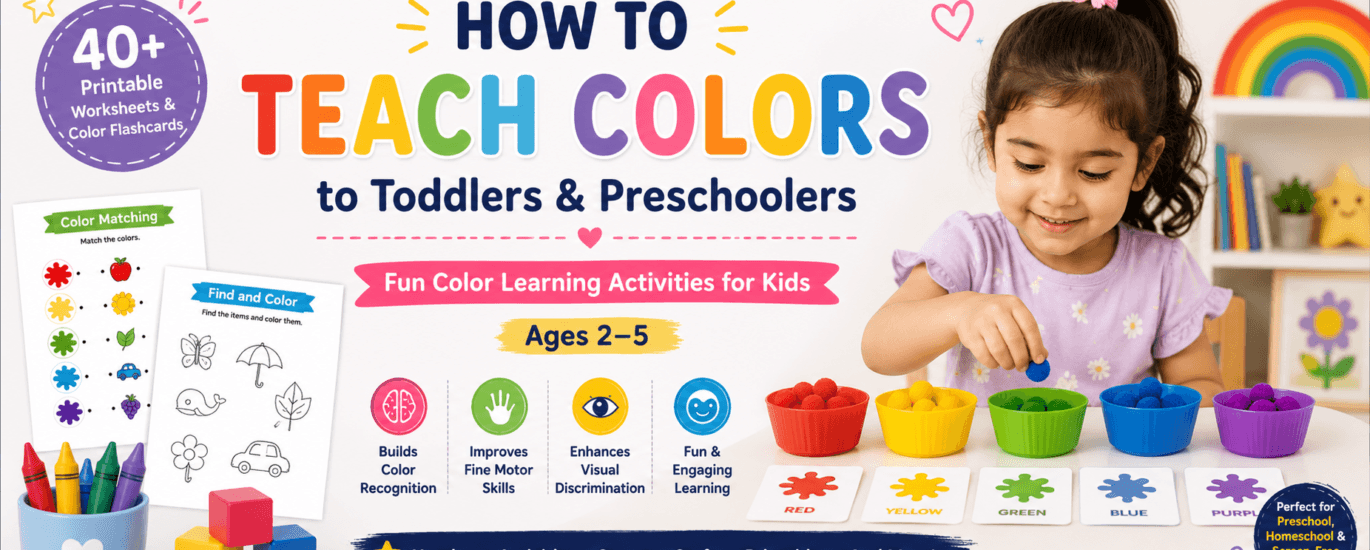
If you’re looking for a ready-to-use collection of color activities for kids ages 2–5, our Colors Activity Bundle for Kids Ages 2–5 includes 40+ printable activities and color-learning flashcards.
The bundle includes activities designed around:
It can be used at home, for preschool practice, homeschooling, quiet time, or screen-free learning.
Explore the Colors Activity Bundle for Kids Ages 2–5 →
Teaching colors should feel like play. A few simple changes can make the experience easier for both parents and children.
Start with a small number of colors and gradually add more.
Introducing every color at the same time can make learning unnecessarily difficult for younger children.
Constantly asking “What color is this?” can make an activity feel like an exam.
Instead, mix questions with observations and conversations.
For example:
Instead of repeatedly asking:
“What color is this?”
Try:
“You picked the yellow crayon!”
Then occasionally ask your child to identify the color when they seem ready.
Children develop skills at different rates.
One child may quickly name several colors, while another may be better at matching colors before they can name them.
Focus on progress rather than comparison.
Color learning isn’t only about memorizing color names.
Give children opportunities to:
These activities provide a richer learning experience.
Here are some simple ways to make learning colors for toddlers part of everyday life:
The goal isn’t to rush your child into memorizing colors. It’s to give them plenty of enjoyable opportunities to notice and use color words.
Once your child enjoys color activities, you can expand learning into other early-learning skills with printable activity packs.
Consider exploring:
These can be linked internally to their respective product pages as you build out your early-learning content library.
Learning colors doesn’t have to involve long lessons or complicated activities.
A toddler can learn while sorting toys, choosing clothes, looking at a picture book, eating fruit, playing outdoors, or creating a colorful craft.
The most effective approach is simple: talk about colors, show colors, play with colors, and repeat them often.
With regular playful practice, toddlers and preschoolers can gradually develop stronger color recognition, matching, sorting, visual discrimination, and early learning skills.
And when you want a little extra structure, printable activities can make it easy to bring purposeful learning into your child’s day.
Looking for ready-to-use color activities? Explore our Colors Activity Bundle for Kids Ages 2–5 with 40+ printable worksheets and color-learning flashcards.