
Summer break is one of my favorite times of the year. The mornings are slower, there’s no rush to pack school bags, and there’s finally enough time to enjoy little moments with our kids. But if you’re anything like me, you’ve probably also heard the words, “Mom, I’m bored!” more times than you can count.
The truth is, keeping children entertained for weeks doesn’t have to mean expensive vacations, fancy toys, or hours of screen time. In fact, some of the best memories are made with simple activities using things you already have at home.
Whether your child loves painting, building, pretending, splashing in water, or experimenting like a little scientist, there’s something magical about learning through play. These small moments not only keep children busy but also help them build creativity, confidence, problem-solving skills, and independence.
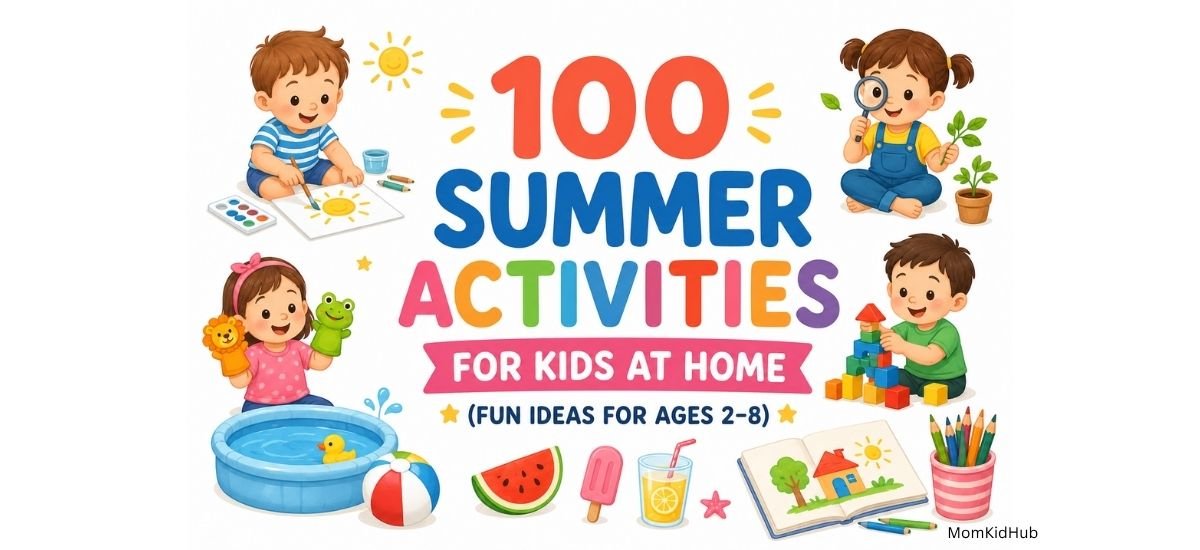
That’s exactly why I put together this list of 100 summer activities for kids. These ideas are simple, budget-friendly, easy to set up, and suitable for toddlers, preschoolers, and young children between the ages of 2 and 8.
Inside this guide, you’ll find:
Whether you’re planning summer vacation at home, looking for rainy-day ideas, or simply trying to reduce screen time, bookmark this guide. You’ll have a new activity ready whenever your little one says they’re bored.
Let’s make this summer full of laughter, creativity, and unforgettable memories!
Summer vacation is more than just a break from school—it’s an opportunity for children to explore, imagine, create, and learn at their own pace.
Kids naturally learn best when they’re playing. Every time they stack blocks, splash water, build a fort, or mix colors, they’re developing important life skills without even realizing it.
Simple summer activities for kids can help strengthen both the body and the brain while making family time even more meaningful.
✅ Encourage creativity and imagination
✅ Improve fine motor and gross motor skills
✅ Reduce unnecessary screen time
✅ Support early learning through play
✅ Build confidence and independence
✅ Improve problem-solving skills
✅ Encourage curiosity and exploration
✅ Develop language and communication skills
✅ Strengthen family bonding
✅ Keep young minds active during school holidays
The best part? Most of these activities require very little preparation and use materials you probably already have at home.
Toddlers love exploring the world with all their senses. They don’t need complicated games—just opportunities to touch, pour, stack, paint, move, and discover.
These activities are designed to be simple, engaging, and perfect for little hands.
Freeze water mixed with a few drops of food coloring in an ice tray. Once frozen, let your toddler hold the colorful ice cubes and paint on thick paper as they slowly melt.
Skills Developed: Fine motor skills, color recognition, sensory exploration
Fill two bowls with water and give your child cups, spoons, ladles, or measuring cups. They’ll love pouring water back and forth for surprisingly long periods.
Skills Developed: Hand-eye coordination, concentration, practical life skills
Place colorful pom poms in a basket and ask your toddler to sort them into muffin trays or bowls based on color.
Skills Developed: Color recognition, sorting, fine motor control
Mix baby shampoo with water using a hand mixer until fluffy foam forms. Add plastic animals or toy cars for extra fun.
Skills Developed: Sensory development, imaginative play
Give your child colorful stickers and a blank sheet of paper. Peeling and sticking stickers is excellent for strengthening tiny finger muscles.
Skills Developed: Fine motor skills, pincer grasp
Call out a color and invite your child to find something around the house that matches it.
“Can you find something yellow?”
It’s a simple game that toddlers absolutely enjoy.
Skills Developed: Observation, vocabulary, color recognition
Pretend to move like different animals.
Hop like a bunny.
Stomp like an elephant.
Waddle like a duck.
Slither like a snake.
Children love acting out different movements.
Skills Developed: Balance, coordination, gross motor skills
Fill a tub with water, soap, and sponges. Let your child wash toy cars, trucks, or construction vehicles.
Expect lots of splashing—and lots of smiles!
Skills Developed: Sensory play, practical life skills
Freeze small plastic toys inside a container of water overnight. The next day, let children rescue them using warm water, squeeze bottles, or toy hammers.
Skills Developed: Problem-solving, patience, sensory exploration
Give children a bucket of water and large paintbrushes.
They can paint fences, patios, sidewalks, or walls. As the water dries, their artwork magically disappears, ready for the next masterpiece.
Skills Developed: Creativity, arm strength
Color uncooked rice using food coloring and vinegar, let it dry, and fill a storage bin with scoops, funnels, and cups.
Toddlers can pour, scoop, and explore for ages.
Skills Developed: Sensory exploration, fine motor development
Go on a short nature walk and collect leaves, flowers, feathers, sticks, pinecones, and smooth stones.
Back home, explore each treasure together and talk about its color, texture, and shape.
Skills Developed: Observation, vocabulary, nature appreciation
Instead of a regular ball, use a balloon.
Children can hit it back and forth without worrying about anyone getting hurt.
This is also perfect for indoor play.
Skills Developed: Hand-eye coordination, movement, teamwork
Draw circles, squares, triangles, and rectangles on paper. Cut matching shapes from colored paper and invite your child to match them.
Skills Developed: Shape recognition, early math skills
Thread cereal loops, large beads, or pasta onto colorful pipe cleaners.
It’s simple, inexpensive, and excellent for strengthening little fingers.
Skills Developed: Fine motor skills, concentration
Use cushions, tunnels, chairs, blankets, and pillows to create a simple obstacle course.
Ask children to crawl under, jump over, and balance through the course.
Skills Developed: Gross motor skills, confidence
Use masking tape to create roads across your floor.
Add toy cars, buses, and traffic signs for hours of imaginative play.
Skills Developed: Pretend play, creativity
Place two buckets outside.
Children soak a sponge in one bucket and squeeze it into the other.
It’s surprisingly entertaining—and fantastic for hand strength.
Skills Developed: Fine motor development, coordination
Instead of scissors, let toddlers tear colorful paper into tiny pieces.
Glue them onto a sheet to create a beautiful collage.
Skills Developed: Finger strength, creativity
Play your child’s favorite songs.
Whenever the music stops, everyone freezes like a statue.
The sillier the poses, the better!
Skills Developed: Listening skills, balance, coordination
Add a few drops of washable paint or food coloring to bubble solution and let children blow bubbles onto paper. As the bubbles pop, they create colorful patterns that turn into unique artwork.
Skills Developed: Creativity, sensory exploration, color recognition
Fill a few small water balloons and place them in a bucket. Using a large spoon or ladle, challenge your child to transfer each balloon to another bucket without dropping it.
Skills Developed: Balance, hand-eye coordination, focus
Collect leaves, grass, flowers, pine needles, or small branches and use them instead of regular paintbrushes. Each natural item creates a different texture on paper.
Skills Developed: Creativity, sensory play, nature exploration
Freeze colorful blocks, toy animals, or large plastic letters inside a bowl of ice. Give children spray bottles filled with warm water to melt the ice and rescue the hidden treasures.
Skills Developed: Patience, observation, problem-solving
Lay strips of bubble wrap across the floor or garden path and let your toddler jump, stomp, crawl, or tiptoe across them.
The popping sounds make this activity an instant favorite!
Skills Developed: Gross motor skills, sensory awareness, balance
Toddlers don’t need elaborate activities to have fun. In fact, the simplest ideas often become the most memorable. A bowl of water, a handful of pom poms, or a roll of masking tape can spark hours of curiosity and imaginative play.
In the next section, we’ll explore 25 exciting summer activities for preschoolers (ages 3–5) that combine creativity, early learning, pretend play, and hands-on discovery.
Preschoolers are naturally curious. They love asking questions, experimenting, pretending, and creating. At this age, every activity becomes an opportunity to learn something new.
The best summer activities for kids in this age group combine fun with early learning. Whether it’s counting ice cream scoops, building a bird feeder, or exploring simple science experiments, children are developing important skills without feeling like they’re doing “school work.”
Here are 25 exciting activities your preschooler will love this summer.
Cut out paper ice cream cones and colorful scoops. Write numbers on each cone and ask your child to place the correct number of scoops on top.
Skills Developed: Counting, number recognition, fine motor skills
Set up a pretend lemonade stand using cups, paper money, and homemade signs. Take turns being the customer and the shopkeeper.
Skills Developed: Communication, imagination, early math
Choose a letter and challenge your child to find objects around the house that begin with that sound.
For example, “B” could be book, ball, banana, or bag.
Skills Developed: Letter recognition, vocabulary, observation
Instead of simply drawing, create hopscotch grids, shape paths, obstacle courses, or giant mazes with sidewalk chalk.
Skills Developed: Gross motor skills, creativity
Fill a plastic container with water, shells, blue stones, toy fish, and sea animals. Add scoops, nets, and cups for open-ended play.
Skills Developed: Sensory exploration, imaginative play
After a walk outdoors, use collected leaves, flowers, sticks, and seeds to create beautiful nature-inspired artwork.
Every collage becomes one of a kind.
Skills Developed: Creativity, observation, fine motor skills
Create a simple bingo board filled with summer-themed pictures such as sunglasses, watermelon, butterflies, ice cream, and sunshine.
This is also a great printable activity for quiet afternoons.
Skills Developed: Visual recognition, concentration
Glue a picture onto several popsicle sticks, then separate them and mix them up. Challenge your child to rebuild the image.
Skills Developed: Problem-solving, sequencing
Write numbers on water balloons and matching numbers on buckets. Children toss each balloon into the correct bucket.
Skills Developed: Number recognition, coordination
Spread peanut butter (or a safe alternative) on a cardboard tube, roll it in birdseed, and hang it outside.
Spend time watching which birds come to visit.
Skills Developed: Nature appreciation, observation
Draw designs using glue and sprinkle salt over them. Add watercolor paint using a dropper and watch the colors spread beautifully.
This activity never gets old!
Skills Developed: Creativity, sensory learning
Gather everyday household objects and ask your child to predict whether each item will sink or float before testing it.
Encourage them to explain their thinking.
Skills Developed: Scientific thinking, prediction skills
Paint a sheet of bubble wrap, flip it onto paper, and gently press. Peel it away to reveal interesting textures and patterns.
Skills Developed: Art exploration, sensory play
Use kinetic sand or homemade taste-safe sand dough inside a tray. Add toy animals, cups, spoons, and molds.
Skills Developed: Sensory development, creativity
Use colored blocks, beads, or paper shapes to create simple AB, ABB, and ABC patterns.
Ask your child to continue each sequence.
Skills Developed: Logical thinking, early math
Gather plastic toys, a bucket of soapy water, brushes, and towels.
Children love giving their toys a good “spa day.”
Skills Developed: Responsibility, practical life skills
Build a blanket fort, switch off the lights, use flashlights, and read bedtime stories inside your pretend campsite.
Add stuffed animals for even more fun.
Skills Developed: Imagination, language development
Using child-safe knives, let children cut bananas, strawberries, cucumbers, or other soft fruits.
Always supervise closely.
Skills Developed: Fine motor skills, independence
Attach paper clips to paper fish and use a homemade magnetic fishing rod to catch them.
Write letters, colors, or numbers on each fish for extra learning.
Skills Developed: Hand-eye coordination, early literacy
Paint a paper plate yellow and decorate it with rays, smiling faces, tissue paper, or handprints.
Display the finished artwork on a wall or window.
Skills Developed: Creativity, fine motor skills
Create paper ice cream scoops in different colors and let children take customer orders.
“What would you like today? Two strawberry scoops with chocolate sprinkles!”
It’s amazing how much language develops during pretend play.
Skills Developed: Communication, imagination, social skills
Go outside on a sunny day and trace the shadows of toys, plants, or even your child’s body using sidewalk chalk.
Return later to see how the shadows have moved.
Skills Developed: Observation, science exploration
Fill several glasses with colored water and connect them using folded paper towels.
Children will be fascinated as the colors slowly travel and mix.
Skills Developed: Science, color mixing, patience
Hide small toys or objects around your garden or home and create simple picture clues to help your child find them.
Add a small prize at the end for extra excitement.
Skills Developed: Problem-solving, observation
Cut old pool noodles into smaller pieces and provide wooden skewers (used only with adult supervision), straws, or craft sticks so children can build towers, robots, or funny creatures.
If you don’t have pool noodles, foam blocks work just as well.
Skills Developed: Engineering thinking, creativity, spatial awareness
Children between three and five years old usually enjoy activities even more when they have choices.
Instead of planning the entire day yourself, try offering two options.
“Would you like to do a science experiment or a craft today?”
Giving children a choice helps build confidence and encourages independence.
You’ll also notice that many preschoolers enjoy repeating their favorite activities again and again. That’s completely normal. Repetition helps strengthen important developmental skills, so don’t worry if your child wants to make another paper plate sun or play in the sensory bin for the third day in a row.
Above all, remember that play doesn’t have to be perfect. A messy craft table, a few spilled cups of water, or paint on tiny fingers often means your child is learning, exploring, and making wonderful summer memories.
Up next, we’ll move on to Summer Activities for Kids (Ages 5–8) with 25 exciting ideas that include STEM challenges, science experiments, engineering projects, creative writing, outdoor adventures, and hands-on learning designed for curious young minds.
By the time children reach five years old, they’re ready for bigger challenges and more independence. They enjoy asking “why,” building things, solving problems, experimenting, and creating projects they can proudly show off.
The best summer activities for kids in this age group encourage curiosity while still feeling like play. These ideas combine science, creativity, engineering, reading, and outdoor exploration to make summer both fun and meaningful.
Turn your kitchen into a mini science lab! Fill a small bottle with baking soda, then pour in vinegar mixed with a few drops of food coloring. Watch the bubbly eruption and talk about the simple chemical reaction happening inside.
Skills Developed: Scientific thinking, observation, curiosity
Save cardboard tubes from paper towels or gift wrap and tape them to a wall or large piece of cardboard. Experiment with different angles to see how the marble travels.
Skills Developed: Engineering, problem-solving, critical thinking
Fold a few sheets of paper together and encourage your child to invent a superhero, funny character, or adventurous animal. Let them illustrate each page and write the dialogue.
Skills Developed: Creative writing, storytelling, imagination
Head outdoors with a notebook and pencils. Children can draw birds, flowers, insects, clouds, or leaves and write a few observations about what they notice each day.
Skills Developed: Observation, writing, scientific inquiry
Can your child build a bridge strong enough to hold a toy car?
Provide popsicle sticks, paper cups, tape, or LEGO bricks and let them experiment with different designs.
Skills Developed: Engineering, creativity, problem-solving
Using craft sticks, rubber bands, and a plastic spoon, build a simple catapult and see how far cotton balls or pom poms can fly.
Challenge your child to improve the design with each attempt.
Skills Developed: Engineering, experimentation
Mix child-safe slime using glue, baking soda, and contact lens solution (or another trusted recipe). Add glitter, beads, or foam balls for extra texture.
Skills Developed: Sensory exploration, measuring, creativity
Draw simple directional arrows on cards and ask your child to move a LEGO figure according to the sequence.
As they improve, create longer coding paths and obstacles.
Skills Developed: Logical thinking, sequencing
Create a reading chart with small rewards for every book completed.
Include storybooks, comics, nonfiction books, or even magazines based on your child’s interests.
Skills Developed: Reading fluency, vocabulary
Using cardboard, markers, dice, and counters, invite your child to create their own board game with rules, challenges, and rewards.
Then enjoy playing it together as a family.
Skills Developed: Creativity, planning, communication
Fold different airplane designs and test which one flies the farthest or stays in the air the longest.
Record the results and discuss why some designs perform better.
Skills Developed: Observation, engineering, prediction
Fill a small box with photos, drawings, favorite memories, postcards, and a letter to your future self.
Seal it and choose a future date to open it together.
Skills Developed: Reflection, writing, memory keeping
Plant herbs, flowers, or vegetables in small pots or recycled containers.
Assign your child the responsibility of watering and observing the plants every day.
Skills Developed: Responsibility, patience, science
Hide a small surprise somewhere in your home or garden and draw a treasure map leading to it.
Add symbols, landmarks, and clues to make the adventure even more exciting.
Skills Developed: Spatial awareness, creativity
Use a pizza box, aluminum foil, and plastic wrap to create a simple solar oven. On a sunny day, try melting chocolate or marshmallows inside.
Always supervise this activity.
Skills Developed: Renewable energy concepts, science
Thread a straw onto a string stretched across the room. Tape an inflated balloon to the straw and release it to watch the balloon rocket zoom across.
Experiment with different balloon sizes.
Skills Developed: Physics, experimentation
Write down five random emojis and challenge your child to create a funny story using all of them.
The sillier the combinations, the more entertaining the stories become.
Skills Developed: Creative thinking, language skills
Fill a jar with fun writing prompts such as:
Pull one prompt each day.
Skills Developed: Writing, imagination
Draw circles with sidewalk chalk or place empty bottles in the yard.
Use water blasters or spray bottles to knock down the targets.
Perfect for hot summer afternoons!
Skills Developed: Aim, coordination
Collect delivery boxes, blankets, pillows, and tape to build an amazing fort.
Decorate it with signs, fairy lights, books, and stuffed animals.
It might even become your child’s favorite reading corner.
Skills Developed: Creativity, teamwork
Create a simple weather journal to record daily temperatures, cloud types, rainfall, and wind conditions.
Compare observations throughout the week.
Skills Developed: Scientific observation, recording data
Blend fruits, yogurt, or juice to create healthy homemade popsicles.
Ask your child to invent their own flavor combinations.
Skills Developed: Measuring, nutrition awareness
Choose one easy experiment using everyday kitchen ingredients.
Ideas include:
Science becomes much more exciting when children can do it themselves.
Skills Developed: Curiosity, experimentation
Provide aluminum foil, paper, straws, and tape.
Challenge children to build a boat that can carry the most coins before sinking.
Encourage them to redesign and improve their boats after each test.
Skills Developed: Engineering, problem-solving
Draw a simple maze on paper.
Instead of moving through it directly, children must write a sequence of arrows showing the correct path before testing their solution.
This introduces basic coding concepts without using screens.
Skills Developed: Computational thinking
Older kids often enjoy taking ownership of their projects. Rather than showing them exactly how something should look, give them the freedom to experiment, make mistakes, and discover their own solutions.
A bridge that falls down, a paper airplane that refuses to fly, or a slime recipe that doesn’t work perfectly on the first try are all valuable learning experiences.
Sometimes the biggest lesson isn’t in getting it right—it’s in trying again.
These moments build resilience, confidence, and creativity far beyond the summer holidays.
In the next section, we’ll wrap up this guide with 25 more summer activities, including quick indoor ideas, exciting outdoor games, practical planning tips, FAQs, and a conclusion to help your family make the most of the season.
Not every day needs a big project or an elaborate setup. Some of the best memories come from spontaneous games, simple crafts, and everyday adventures. These last 25 summer activities for kids are perfect for mixing into your weekly routine whenever you need a quick idea.
When it’s too hot outside or unexpected rain changes your plans, these indoor activities can keep kids happy, active, and learning.
Gather pillows, blankets, chairs, and cushions to build a cozy fort. Add fairy lights, books, stuffed animals, and snacks to make it even more magical.
Skills Developed: Creativity, teamwork, imaginative play
Create a playlist with your child’s favorite songs and dance together for 20–30 minutes. Let each family member choose a song and invent a dance move.
Skills Developed: Gross motor skills, confidence, coordination
Use empty plastic bottles as bowling pins and roll a soft ball to knock them down. Add points to make it more exciting.
Skills Developed: Hand-eye coordination, balance
Draw different lines and shapes on colorful paper for children to cut. Turn the pieces into a collage or greeting card afterward.
Skills Developed: Fine motor skills, hand control
Fill a binder with printable mazes, tracing pages, coloring sheets, matching games, and puzzles that children can complete independently.
Skills Developed: Independent learning, concentration
Print age-appropriate mazes and race against a timer to solve them.
You can even laminate them and use dry-erase markers for repeated use.
Skills Developed: Problem-solving, visual tracking
Scatter cushions across the room and challenge everyone to move from one side to the other without touching the “lava.”
Add extra challenges like crawling or balancing on one foot.
Skills Developed: Balance, coordination, physical activity
Roll homemade story dice with pictures or words and create a story using whatever appears.
No two stories will ever be the same.
Skills Developed: Storytelling, imagination
Spread a blanket on the living room floor and enjoy lunch or snacks picnic-style.
Read a story or play a board game afterward.
Skills Developed: Family bonding, social interaction
Turn delivery boxes into castles, rockets, dollhouses, race cars, shops, or pirate ships.
Give children markers, stickers, tape, and let their imagination lead the way.
Skills Developed: Creativity, engineering, pretend play
Fresh air, sunshine, and open spaces make outdoor play extra special during summer. These activities encourage movement, exploration, and plenty of laughter.
Draw hopping spots, zigzag lines, balance beams, circles, and jumping stations using sidewalk chalk.
Time each run to add an exciting challenge.
Skills Developed: Gross motor skills, coordination
Pair up and toss water balloons back and forth, taking a step backward after every successful catch.
Prepare to get soaked!
Skills Developed: Teamwork, coordination
Pitch a small tent in your backyard or balcony.
Tell stories, enjoy snacks, watch the stars, and pretend you’re on a camping adventure.
Skills Developed: Imagination, family bonding
Who can make the biggest bubble?
Who can pop the most bubbles in one minute?
Simple games like these bring endless excitement.
Skills Developed: Observation, movement
Collect leaves, flowers, feathers, or pinecones and use them as natural paintbrushes or stamps to create beautiful artwork.
Skills Developed: Creativity, sensory exploration
If you have a garden or outdoor space, connect a sprinkler or create a splash zone using a hose and shallow tubs of water.
It’s one of the easiest ways to stay cool during hot summer afternoons.
Skills Developed: Physical activity, sensory play
Invite your child to plant flowers, herbs, or vegetables.
Water them every day and observe how they grow over the coming weeks.
Skills Developed: Responsibility, patience
Set up old pots, spoons, bowls, and containers outdoors.
Children can create mud cakes, leaf soup, or pretend recipes while exploring different textures.
Skills Developed: Sensory exploration, imaginative play
Create a checklist with items such as:
See how many your child can find.
Skills Developed: Observation, nature appreciation
Pack simple sandwiches, fruits, and drinks, then head to a nearby park.
Bring a ball, frisbee, or favorite book for a relaxed family outing.
Skills Developed: Social interaction, outdoor exploration
Having lots of ideas is wonderful, but you don’t need to do everything in one week. Children benefit more from relaxed, enjoyable experiences than from a packed schedule.
Here are a few tips that have worked well in our home:
Remember, children don’t measure a successful summer by how many activities they completed. They remember how much fun they had and the time they spent with the people they love.
Some of the best summer activities for kids include water play, sensory bins, arts and crafts, STEM experiments, scavenger hunts, pretend play, obstacle courses, gardening, and printable learning activities. The key is choosing activities that match your child’s age and interests.
Create a flexible daily routine that includes outdoor play, reading, creative projects, and independent activities. Keeping simple supplies like crayons, play dough, building blocks, and printable worksheets within easy reach encourages children to play without relying on screens.
Toddlers enjoy sensory bins, bubble play, water transfer stations, color hunts, sticker activities, animal walks, simple crafts, and outdoor water painting. These activities help develop fine motor skills while keeping little ones engaged.
Yes! Every activity in this guide supports important developmental skills such as creativity, language development, problem-solving, early math, science exploration, fine motor development, and social skills. Children learn naturally through hands-on play.
A basic activity basket can include washable paints, crayons, markers, construction paper, glue, child-safe scissors, popsicle sticks, pom poms, pipe cleaners, stickers, play dough, bubbles, measuring cups, and recyclable materials like cardboard boxes and paper tubes.
You don’t need expensive toys to keep kids entertained, but a few versatile supplies can make planning activities much easier.
Some of our family favorites include:
👉 You can find all of our favorite activity supplies in our curated Amazon Storefront:
🛒 Shop Our Summer Activity Essentials on Amazon: Click Here
We’ve personally selected products that make learning through play easy, fun, and affordable for families.
Affiliate Disclosure: Some of the links on this page are affiliate links. This means that if you make a purchase through these links, MomKidHub may earn a small commission at no additional cost to you. We only recommend products that we genuinely love, use, or believe will add value to your family’s play and learning journey. Thank you for supporting MomKidHub!
Summer isn’t about creating a picture-perfect schedule or planning something exciting every single day. It’s about slowing down, spending quality time together, and giving children the freedom to explore, imagine, and simply enjoy being kids.
Whether you try five activities or all one hundred, remember that the little moments often become the biggest memories. A cardboard fort in the living room, a homemade science experiment at the kitchen table, or a simple water balloon game in the backyard can bring just as much joy as an expensive day out.
I hope this list of 100 summer activities for kids gives you plenty of inspiration for a fun-filled, screen-free summer. Save this guide, come back whenever you need a fresh idea, and don’t be afraid to adapt the activities to suit your child’s interests and abilities.
Most importantly, have fun, embrace the mess, and enjoy making beautiful memories together.
If you enjoyed these summer activities for kids, you might also love these ideas from MomKidHub:
Happy Summer! ☀️