
Have you ever wondered why we celebrate Janmashtami every year?
You may have seen little Krishna decorations, colourful rangoli, tiny footprints, butter pots, peacock feathers, or children dressed as Krishna and Radha. You may have even heard bhajans playing at midnight.
But what is Janmashtami, and why is this festival so special?
Janmashtami is the festival that celebrates the birth of Lord Krishna, one of the most loved and celebrated figures in Hindu tradition.
The story of Krishna’s birth is filled with courage, hope, faith, and many wonderful moments. So, let’s travel back a very, very long time ago and discover the story together.
Janmashtami is celebrated to mark the birth of Lord Krishna.
The word Janmashtami comes from two words:
According to Hindu tradition, Krishna was born on the eighth day (Ashtami) of the Krishna Paksha, during the month of Shravana or Bhadrapada, depending on the lunar calendar followed.
Krishna is traditionally believed to have been born at midnight in Mathura.
That is why many Janmashtami celebrations continue late into the night, with prayers and devotional songs around midnight.
But before we talk about the celebrations, let’s find out what happened on that special night.
📖 Want to Read Krishna’s Birth Story?
The story of Krishna’s birth is one of the most beautiful parts of Janmashtami. If your child would like to follow the story from Mathura to Gokul in more detail, read our [Janmashtami Story for Kids].
A very long time ago, there was an ancient city called Mathura.
Mathura was ruled by a king named Kansa.
Kansa was powerful, but he was also cruel and selfish. He wanted to remain powerful and was afraid of losing his throne.
Kansa had a sister named Devaki.
Devaki married a noble man named Vasudeva.
At first, everything seemed peaceful.
But then something happened that changed their lives forever.
According to the traditional story, one day Kansa heard a divine voice telling him something frightening:
The eighth child of Devaki would be the one who would bring an end to Kansa.
Kansa became terrified.
He did not want to lose his power, so he decided that he would do everything he could to prevent the prophecy from coming true.
Devaki and Vasudeva were imprisoned by Kansa.
Their children were born in prison, and Kansa cruelly tried to prevent the prophecy from being fulfilled.
But destiny had something very different planned.
After a difficult time in prison, the eighth child of Devaki and Vasudeva was born.
It was a beautiful baby boy.
His name was Krishna.
According to the traditional account, Krishna’s birth was no ordinary birth. He was born at midnight, when the prison was quiet and dark.
Devaki and Vasudeva knew that their baby was in great danger.
They had to find a way to keep him safe.
And then, something extraordinary happened.
As soon as Krishna was born, the story tells us that several miraculous things happened.
The chains that bound Vasudeva came loose.
The guards who were watching the prison fell into a deep sleep.
And the heavy prison doors opened.
Vasudeva understood that this was his chance to take baby Krishna somewhere safe.
He carefully placed the tiny baby in a basket.
Then he lifted the basket onto his head and quietly walked out of the prison.
But his journey was only beginning.
Outside, the night was dark and stormy.
Rain poured from the sky.
Vasudeva made his way towards the Yamuna River, carrying baby Krishna safely in the basket.
But the Yamuna was flowing strongly.
How could Vasudeva cross such a deep and fast-moving river while carrying a tiny baby?
According to the traditional story, something wonderful happened.
As Vasudeva entered the river, the waters became calm enough for him to cross.
He carefully continued through the water, making sure that baby Krishna remained safe.
But the rain was still falling heavily.
And then another miraculous protector appeared.
A giant serpent named Sheshnag appeared.
Sheshnag spread his many hoods above baby Krishna, creating a protective cover over him.
It was almost like a giant umbrella!
While the rain continued to fall, Sheshnag protected Krishna from the storm.
Vasudeva continued his journey across the Yamuna.
Eventually, he reached a village called Gokul.
And there, Krishna’s life took a new turn.
In Gokul lived Nanda and Yashoda.
Vasudeva safely brought baby Krishna to their home.
Krishna was then raised by Yashoda and Nanda, who loved him dearly.
After leaving Krishna safely in Gokul, Vasudeva returned to the prison.
And so, the little baby who had been born in a prison in Mathura began his childhood in the loving home of Gokul.
Krishna grew up to be a cheerful, playful and mischievous little boy.
He loved spending time with his friends.
He loved playing his flute.
He loved cows.
And, of course, he absolutely loved butter!
Krishna’s childhood stories are some of the most beloved stories associated with him.
He was curious, playful and full of energy.
And sometimes, his love for butter got him into a little trouble!
Krishna was famous for his love of butter.
The stories say that he would often sneak into homes with his friends to find pots filled with freshly made butter.
Sometimes, the butter pots were kept high up so that Krishna could not reach them.
But that did not stop him!
Krishna and his friends would find clever ways to reach the butter.
Because of these playful stories, Krishna is lovingly known as Makhan Chor, which means “butter thief.”
The stories of Krishna stealing butter remind us that Krishna’s childhood was filled with joy, friendship and plenty of mischief.
That is also why butter and decorated matkis (clay pots) have become such popular symbols of Janmashtami.
So, why do we celebrate Janmashtami every year?
The simplest answer is:
Janmashtami celebrates the birth of Lord Krishna.
But the festival also has a deeper meaning.
Krishna’s story reminds people about the importance of goodness, courage, hope and faith.
His birth is celebrated as a moment when hope appeared during a difficult time.
For children, Janmashtami can be a beautiful opportunity to learn that even when things seem difficult, we can choose to be brave, kind and hopeful.
Janmashtami is celebrated in many different ways across India and around the world.
Different families and communities have their own traditions, but some common celebrations include:
Homes, temples and prayer areas may be decorated with flowers, lights, rangoli, peacock feathers and other colourful decorations.
Some families also make tiny footprints leading towards a Krishna idol.
These footprints are meant to represent baby Krishna entering the home.
People gather to sing devotional songs and bhajans dedicated to Krishna.
Many families visit temples or offer prayers at home.
Since Krishna is traditionally believed to have been born at midnight, many devotees gather around midnight to celebrate his birth.
Children often dress up as little Krishna.
A small yellow dhoti, a peacock feather crown and a flute are popular parts of a Krishna-inspired costume.
Since Krishna is famous for his love of butter, butter pots or matkis are often included in Janmashtami decorations and activities.
In many parts of India, especially Maharashtra, Dahi Handi is an important Janmashtami tradition.
A pot filled with curd or other food is hung high above the ground, and teams work together to reach it.
The tradition is inspired by stories of Krishna and his friends trying to reach pots of butter and curd.
Want to explore Janmashtami beyond Krishna’s birth story?
Read our complete [Janmashtami for Kids] guide to discover the festival’s traditions, Dahi Handi, Krishna’s symbols, fun facts, values, and more.
Here are some simple facts children can remember:
🦚 Krishna is often shown wearing a peacock feather.
🪈 The flute is one of the objects most closely associated with Krishna.
🧈 Krishna is famous for his love of butter.
🐄 Cows are an important part of many Krishna stories.
🌙 Krishna’s birth is traditionally celebrated at midnight.
🏺 Matkis are often used in Janmashtami decorations because of Krishna’s butter-stealing stories.
🏡 Krishna spent his childhood in Gokul with Nanda and Yashoda.
🎉 Janmashtami is celebrated with prayers, bhajans, decorations and many different cultural traditions.
Festivals become even more meaningful for children when they can learn through stories, play and hands-on activities.
After reading the story of Krishna’s birth, you can ask your child:
You can also encourage children to draw Krishna, decorate a matki, colour a peacock feather or make their own Janmashtami craft.
To make learning about Janmashtami even more fun, we have created a FREE 10-sheet Janmashtami Activity Bundle for kids.
The activities are designed to combine learning, creativity and play while introducing children to Krishna and the festival of Janmashtami.
🦚 Krishna colouring activities
🧈 Matki and butter-themed activities
🔢 Number and counting activities
🧩 Krishna-themed puzzles
👣 Krishna footprint tracing
🎨 Creative colouring and decorating activities
🪈 Pattern activities
✂️ Cut, colour and paste activities
🌙 Janmashtami-themed learning activities
💙 Fun activities inspired by little Krishna
The worksheets are designed for children to colour, trace, match, count, cut, paste and create.
DOWNLOAD THE FREE JANMASHTAMI WORKSHEETS FOR KIDS
Print the sheets at home and let your little one enjoy some screen-free Janmashtami fun while learning about the festival.
Janmashtami is more than just a festival with decorations, sweets and dressing up.
It is also a wonderful opportunity to introduce children to Indian stories, traditions and values in a way they can understand.
You don’t need to explain everything at once.
Start with the story.
Ask questions.
Let your child colour Krishna.
Make a little matki together.
Listen to a Krishna bhajan.
Look at a peacock feather.
And most importantly, let children enjoy the magic and joy of the festival.
Through stories like Krishna’s, children can discover ideas such as love, courage, friendship, kindness, hope and doing what is right.
From the mysterious night of Krishna’s birth in Mathura to his playful childhood in Gokul, the story of Krishna has been shared from generation to generation.
Janmashtami gives families a beautiful reason to come together, tell stories, pray, create, play and celebrate.
So this Janmashtami, read the story with your little one, enjoy some Krishna-themed activities and make a few happy memories together.
🦚 Happy Janmashtami! 💙
Jai Shri Krishna! 🙏
Why Should We Not See the Moon on Ganesh Chaturthi? The Story of Ganesha and the Moon
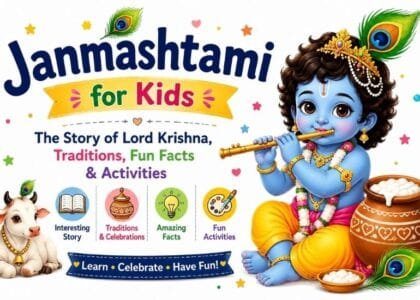
Janmashtami for Kids: The Story of Lord Krishna, Traditions, Fun Facts & Activities
Brain Activities for Kids: Fun Brain Gym & Brain-Boosting Worksheets