
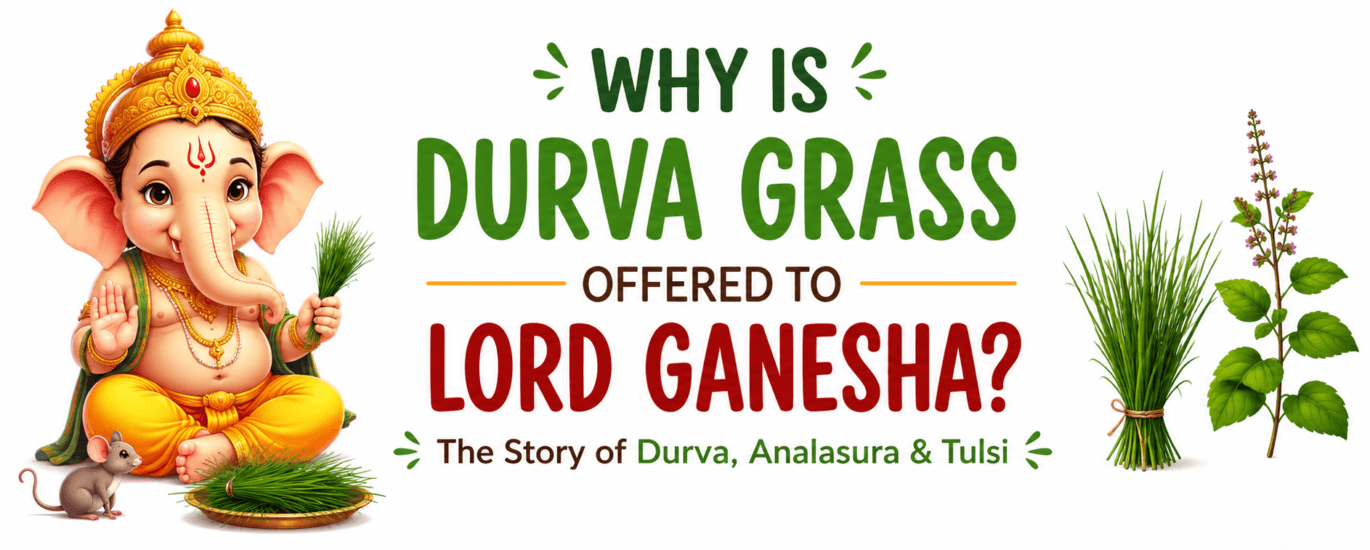
Why do we offer green grass to Lord Ganesha? 🌿🐘
If you have ever seen a Ganesh puja, you may have noticed something simple but special placed near Lord Ganesha — small bunches of green grass called Durva.
For children, it may seem surprising.
Why would we offer grass to Lord Ganesha?
Durva is not just an ordinary blade of grass in Hindu tradition. It has a special place in Ganesha puja, and there is a beautiful traditional story that explains why.
The story takes us back to a powerful demon named Analasura, Lord Ganesha’s brave act of protecting everyone, and how Durva helped cool Ganesha after the battle.
There is also an interesting traditional story about Tulsi and Ganesha, which explains why Tulsi leaves are generally not offered to Lord Ganesha.
Let’s read these stories in a simple, child-friendly way.
Durva is a type of green grass that is traditionally offered to Lord Ganesha during puja.
It is also commonly called Doob or Doob grass (दूब).
Durva is usually offered in small bunches rather than as just one blade of grass.
You may see devotees placing Durva near a Ganesha idol during:
But why is this simple grass considered so special?
For that, we need to hear the story of Analasura.
Long ago, there was a powerful demon named Analasura.
The name Analasura is connected with Anala, meaning fire or heat.
Analasura was said to have tremendous heat in his body. His presence created fear and trouble, and people and the gods were worried about him.
Everyone wanted the suffering to end.
They turned to Lord Ganesha for help.
Lord Ganesha decided to protect everyone.
He faced Analasura and fought the powerful demon.
The battle was fierce.
But Lord Ganesha was stronger.
In the end, Ganesha defeated Analasura.
According to the traditional story, Ganesha then swallowed Analasura.
The danger was over.
Everyone was safe.
But there was one problem…
After swallowing Analasura, Lord Ganesha began to feel an intense heat inside his body.
He felt extremely uncomfortable.
The gods tried different ways to cool him down.
Some stories say that they tried many different remedies, but nothing seemed to help.
Lord Ganesha continued to feel the burning heat.
Everyone was worried.
Then something simple came to the rescue.
Durva grass. 🌿
According to this popular traditional story, sages placed Durva grass on Lord Ganesha.
They offered him 21 blades of Durva, arranged as a small bunch.
And something wonderful happened.
The heat that had been troubling Ganesha began to disappear.
The simple green grass brought relief to him.
Lord Ganesha became cool and comfortable again.
And this is one of the traditional stories associated with the special place of Durva in Ganesha worship.
You may have noticed that Durva is often offered in groups of 21 during Ganesha puja.
The number 21 is traditionally considered special in Ganesha worship.
Different traditions explain the significance of 21 in different ways.
In the Analasura story, the offering of 21 Durva is associated with cooling and calming Lord Ganesha after he swallowed Analasura.
For children, the simple takeaway is:
🌿 21 Durva → a special traditional offering to Lord Ganesha.
The story of Analasura is one reason Durva has become an important offering in Ganesha puja.
It teaches us that something that looks very small and ordinary can also have great importance.
A simple blade of grass may not look special to us.
But in a beautiful traditional story, Durva brought relief to Lord Ganesha when nothing else could.
That is why devotees continue to offer Durva to Ganesha.
The story can teach children a lovely lesson:
Never think that something is unimportant just because it is small or simple.
The mighty Lord Ganesha was helped by something as simple as green grass.
It reminds us to appreciate nature and not take small things for granted.
Now comes another interesting question.
If Durva is traditionally offered to Ganesha, why isn’t Tulsi usually offered to him?
Tulsi, also known as holy basil, is considered a very sacred plant in many Hindu traditions.
Yet there is a popular traditional story that explains why Tulsi is generally not offered to Lord Ganesha.
Let’s hear that story too.
According to a popular traditional story, Tulsi once saw Lord Ganesha.
She admired him and wished to marry him.
Tulsi expressed her desire to marry Ganesha.
But Ganesha did not want to marry her.
He politely refused.
Tulsi became upset because Ganesha had rejected her wish.
The conversation became an argument.
In anger, Tulsi and Ganesha exchanged curses.
Later, both realized that what had happened was unfortunate.
But because of this story, Tulsi came to be traditionally associated with a different place in worship.
As a result, Tulsi leaves are generally not offered to Lord Ganesha.
Both Durva and Tulsi are plants that have an important place in Indian traditions.
But their traditional association with Lord Ganesha is different.
Durva grass is traditionally offered to Lord Ganesha.
It is connected with the story of Analasura, where Durva helped cool Ganesha after he swallowed the demon.
Tulsi is a sacred plant and is offered in many Hindu prayers.
However, according to the popular story of Tulsi and Ganesha, Tulsi is traditionally not offered to Ganesha.
So remember it this way:
🌿 Durva → offered to Ganesha
🌱 Tulsi → traditionally not offered to Ganesha
Stories from our traditions are a wonderful way for children to learn about festivals and prayers.
When children hear that Durva is offered to Ganesha, they may simply remember the rule.
But when they learn the story behind it, the tradition becomes much more meaningful.
They can understand:
🌿 What Durva is
🐘 Why it is offered to Ganesha
🔥 Who Analasura was
🌱 Why Tulsi is traditionally not offered to Ganesha
❤️ How stories help us understand traditions
These stories also encourage children to ask questions and learn more about their culture.
Here is the whole story in just a few lines:
Long ago, the demon Analasura caused trouble with his tremendous heat.
Lord Ganesha came to protect everyone and defeated him.
Ganesha swallowed Analasura, but the heat made Ganesha feel very uncomfortable.
The gods tried to cool him, but nothing worked.
Then Durva grass was placed on Ganesha, and the heat went away.
That is why Durva became a special traditional offering to Lord Ganesha. 🌿🐘
And according to another popular traditional story:
Tulsi wished to marry Ganesha, but he refused. An argument followed, and curses were exchanged. Because of this story, Tulsi is traditionally not offered to Ganesha. 🌱
Traditions are often filled with stories.
A small bunch of Durva may look ordinary, but it carries a story that has been shared for generations.
When we teach children these stories, we are not only teaching them what to do during a puja.
We are also helping them understand the meaning, stories, and traditions behind our festivals.
So the next time your child sees Durva being offered to Lord Ganesha, you can tell them:
“This little grass has a big story!” 🌿🐘
And perhaps that simple story will make their Ganesh Chaturthi a little more meaningful.
Durva is a type of green grass that is traditionally offered to Lord Ganesha during puja. It is also commonly known as Doob or दूब.
According to a popular traditional story, Durva helped cool Lord Ganesha after he swallowed the demon Analasura, whose body was associated with tremendous heat.
Analasura was a powerful demon who caused trouble with his intense heat. Lord Ganesha fought him and swallowed him. Afterward, Ganesha felt extremely hot, and Durva grass helped cool him.
Offering 21 Durva is a traditional practice in Ganesha worship. Different traditions give different explanations for the significance of the number 21.
According to a popular traditional story, Tulsi wished to marry Ganesha, but he refused. After an argument, curses were exchanged. Because of this story, Tulsi is traditionally not offered to Lord Ganesha.
Absolutely! The story is simple enough to share with children and is a lovely way to help them understand the traditions associated with Ganesh Chaturthi.
Ganesh Chaturthi is a wonderful time to introduce children to the stories of Lord Ganesha.
Instead of only telling children “We offer Durva because it is traditional,” tell them the story behind it.
Stories make traditions easier for children to remember — and much more fun to learn!
🌿 Learn the story.
🐘 Understand the tradition.
❤️ Pass it on to the next generation.
Happy Ganesh Chaturthi! 🐘🌿✨
If your child enjoyed learning the story behind Durva grass, explore these fun and simple guides to learn more about Lord Ganesha, Ganesh Chaturthi, and Indian traditions: