
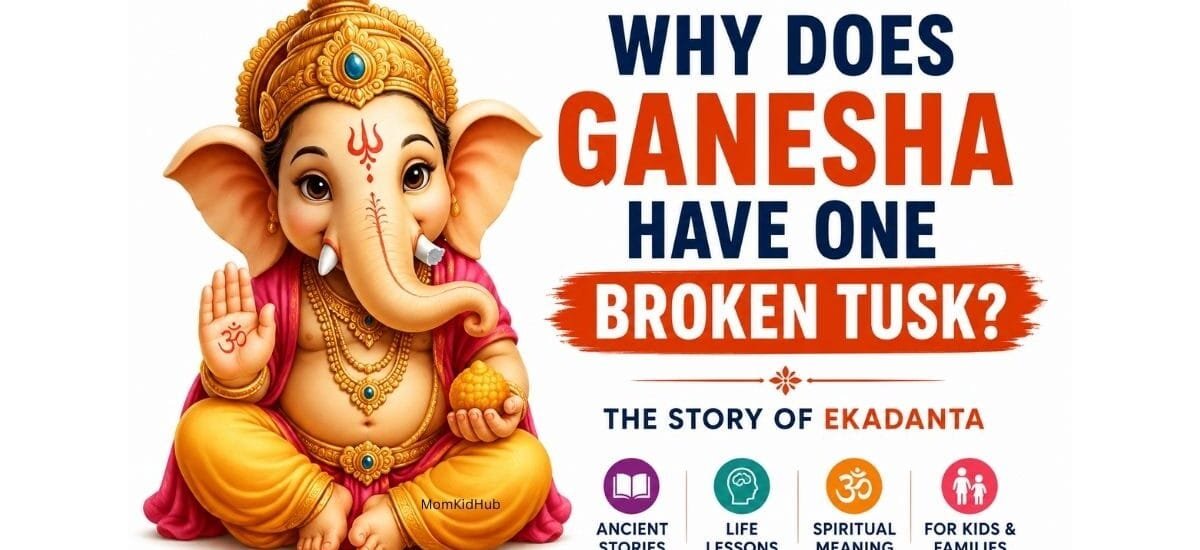
If you’ve ever looked closely at a statue or picture of Lord Ganesha, you may have noticed something unusual—he has one complete tusk and one broken tusk.
Have you ever wondered why?
Lord Ganesha’s appearance is full of symbolism. From his elephant head and large ears to his tiny eyes, curved trunk, and broken tusk, every feature is believed to carry an important life lesson.
His broken tusk is so special that it gave Lord Ganesha one of his most well-known names: Ekadanta, which means “the one with a single tusk.”
But how did Lord Ganesha lose his tusk?
Hindu mythology contains several fascinating stories about his broken tusk. These stories teach us about wisdom, sacrifice, humility, determination, and creative problem-solving.
Let’s explore them!
The Sanskrit word Ekadanta is made up of two words:
Eka = One
Danta = Tusk or tooth
Together, Ekadanta means “The One with a Single Tusk.”
Ekadanta is one of the many sacred names of Lord Ganesha and appears in traditional Sanskrit prayers and scriptures.
His single tusk is often seen as a reminder that true strength does not come from physical perfection. It comes from wisdom, focus, courage, and inner strength.
One of the most famous legends about Ganesha’s broken tusk is connected to the Mahabharata, one of the world’s great epic poems.
According to a popular Hindu tradition, the sage Ved Vyasa wanted someone wise and capable enough to write down the Mahabharata as he recited it.
He chose Lord Ganesha because of his extraordinary wisdom and intellect.
Ganesha agreed to write, but he placed one condition before Vyasa:
He would not stop writing once the recitation began.
Vyasa agreed, but he had a condition too.
He said that Ganesha must understand each verse completely before writing it down.
The recitation began.
Ganesha wrote quickly as Vyasa dictated the verses.
Then, suddenly, his writing instrument broke!
Ganesha did not want to stop because he had promised to continue writing without interruption.
So, without hesitation, he broke off one of his own tusks and used it as a pen.
He continued writing, and the great work could be completed.
This beautiful story teaches children that:
Because of this story, Ganesha’s broken tusk is often seen as a symbol of knowledge, wisdom, sacrifice, and determination.
Another popular Hindu legend connects Ganesha’s broken tusk with Lord Parashurama, one of the avatars of Lord Vishnu.
According to the story, Parashurama once visited Mount Kailash to meet Lord Shiva.
At that time, Lord Shiva was resting.
Lord Ganesha was guarding the entrance and politely asked Parashurama to wait.
Parashurama wanted to enter and became angry when Ganesha stopped him.
The disagreement eventually turned into a battle between the two.
During the battle, Parashurama threw his powerful divine axe, which had been given to him by Lord Shiva.
Ganesha recognized the weapon as his father’s gift.
Rather than using all his strength to stop it, Ganesha chose to respect the weapon and his father’s gift.
The axe struck Ganesha’s tusk and broke it.
This story reminds us that:
There are also traditions that tell a different story about Ganesha’s tusk.
According to some versions, Ganesha intentionally broke off his tusk and used it as a weapon to fight evil and remove obstacles.
Instead of depending on a powerful or complicated weapon, he used something he already had.
This story teaches children that:
Although the stories are different, they all carry meaningful lessons.
In the Mahabharata story, Ganesha willingly gives up his tusk so that the great work can continue.
It reminds us that sometimes achieving something meaningful requires sacrifice and dedication.
Lord Ganesha is worshipped as a symbol of wisdom and knowledge, even though he has a broken tusk.
His story reminds children that who we are and what we learn are much more important than how we look.
When Ganesha’s pen broke, he didn’t simply stop.
He found another solution and continued with the task he had promised to complete.
This teaches children the importance of commitment and perseverance.
The story involving Parashurama shows Ganesha choosing respect and self-control instead of simply using his strength.
It reminds us that being powerful doesn’t mean we always have to show our power.
A broken pen could have stopped Ganesha.
Instead, he turned his own tusk into a writing instrument.
What a wonderful reminder for children:
When one solution doesn’t work, look for another!
Here are some fascinating facts children will love:
📖 Ganesha is traditionally described as the scribe of the Mahabharata in a popular Hindu legend.
🐘 His broken tusk is one of the most recognizable features of Lord Ganesha in paintings, sculptures, and illustrations.
🙏 Ekadanta is one of Lord Ganesha’s many sacred names.
🎓 Ganesha is associated with wisdom, knowledge, learning, and removing obstacles, which is why many students and families offer prayers to him before beginning something important.
🌺 Ganesh Chaturthi is a major Hindu festival celebrating Lord Ganesha. During the festival, devotees worship Ganesha and remember the values he represents, including wisdom, humility, courage, and perseverance.
🛕 Many features of Ganesha’s form have symbolic meanings. His large ears are often associated with listening carefully, his small eyes with concentration and focus, his trunk with adaptability, and his broken tusk with sacrifice, wisdom, and determination.
The story of Ganesha’s broken tusk is much more than a story about how he lost a tooth.
It can help parents and teachers start conversations with children about important life values.
The broken tusk teaches us to:
✨ Keep our promises.
✨ Never give up when we face challenges.
✨ Respect others, even when we disagree.
✨ Think creatively when something goes wrong.
✨ Value knowledge and learning.
✨ Understand that imperfections do not make us less special.
✨ Use our strengths wisely.
One of the most beautiful lessons is that something that appears to be an imperfection can become a symbol of strength and wisdom.
According to different Hindu legends, Ganesha’s tusk was either broken while he was writing the Mahabharata or was broken during his encounter with Lord Parashurama. Both stories are associated with important values such as wisdom, sacrifice, humility, and determination.
Ekadanta means “the one with a single tusk.” It is one of Lord Ganesha’s sacred names and is associated with wisdom, focus, and spiritual strength.
According to one of the most famous Hindu legends, yes. When his writing instrument broke while he was writing the Mahabharata, Ganesha used his own tusk so that he could continue writing without breaking his promise to Sage Vyasa.
The broken tusk teaches children about perseverance, creativity, humility, sacrifice, self-control, and the importance of valuing knowledge over comfort.
The Sanskrit name Ekadanta means “One-Tusked” or “the one with a single tusk.” It is one of the many names used for Lord Ganesha.
The story of Lord Ganesha’s broken tusk reminds us that every challenge can carry a lesson.
A broken tusk became a symbol of wisdom.
A difficult situation became an opportunity for creative thinking.
And a sacrifice became part of a story remembered for generations.
Whether children hear the story of Ganesha writing the Mahabharata, his encounter with Parashurama, or another traditional version, the message remains powerful:
Be wise. Be humble. Keep trying. Think creatively. And never let an obstacle stop you from moving forward.
That is what makes Lord Ganesha’s broken tusk such a beautiful lesson for children—and for all of us.