
Long ago, on Mount Kailash, Lord Ganesha and his brother Lord Kartikeya were with their parents, Lord Shiva and Goddess Parvati.
One day, Goddess Parvati had a very special modak.
But this was no ordinary modak.
It was said to be a divine sweet filled with the blessings of wisdom and knowledge.
Both Ganesha and Kartikeya wanted the special modak.
So Goddess Parvati decided to give them a challenge.
She smiled and said,
“Whoever goes around the world and comes back first shall receive this modak.”
The challenge had begun!
Kartikeya immediately climbed onto his beautiful peacock.
With his peacock spreading its magnificent feathers, Kartikeya flew off into the sky.
He travelled far and wide, crossing mountains, forests, rivers and lands.
He was determined to be the first one to return to Mount Kailash and win the special modak.
Ganesha looked at his brother disappearing into the distance.
His vehicle was his tiny mouse, and he knew that travelling around the entire world on his little mouse would take a very long time.
But Ganesha was known for his wisdom.
Instead of rushing off, he stopped and thought.
Then he looked at his parents, Lord Shiva and Goddess Parvati.
Suddenly, he had an idea.
Ganesha walked towards his parents.
And then…
He slowly walked around them once.
Then he walked around them a second time.
And finally, he completed the third round.
Lord Shiva and Goddess Parvati looked at him with surprise.
“Ganesha,” asked Parvati, “what are you doing?”
Ganesha smiled.
He folded his hands and said,
“You are my whole world, Maa and Papa. For me, there is no world greater than my parents.”
According to Ganesha, his parents were the source of his love, care, learning and everything he knew.
So, by going around them, he believed he had gone around his entire world.
When Goddess Parvati heard Ganesha’s answer, she was deeply touched.
She saw that Ganesha had understood something that his brother had missed.
The challenge was not simply about who could travel the fastest.
It was about wisdom and understanding.
Kartikeya had travelled around the world.
Ganesha had understood what the world truly meant to him.
And so, Goddess Parvati gave the divine modak to Ganesha.
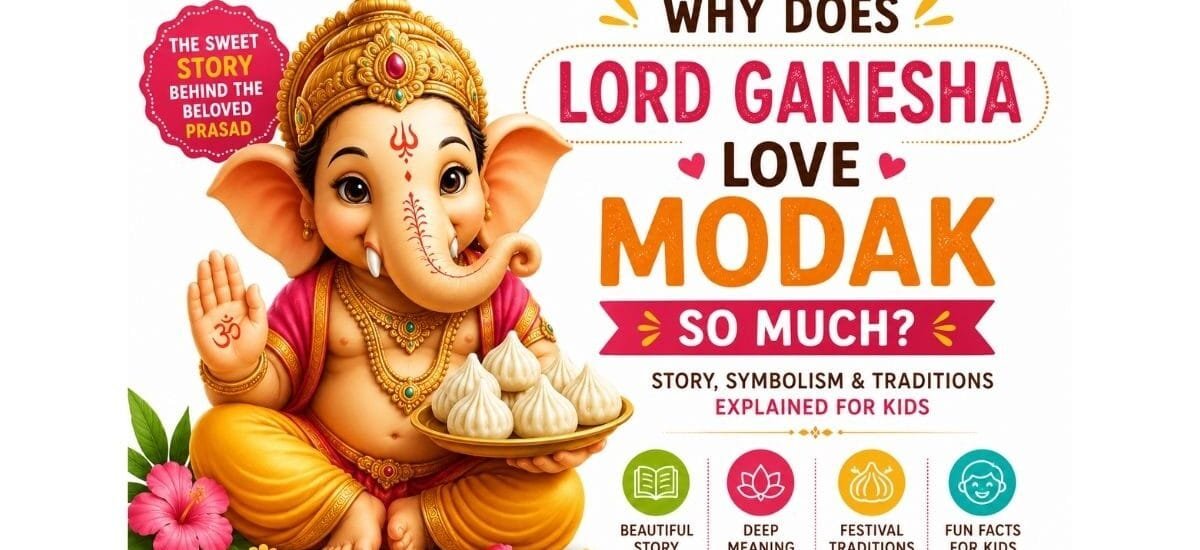
From this beautiful story grew the loving association between Lord Ganesha and the modak.
That is why, even today, devotees lovingly offer modaks to Bappa during Ganesh Chaturthi.
This isn’t just a story about a delicious sweet.
It carries a beautiful lesson.
Kartikeya was fast, but Ganesha stopped to think.
Sometimes, the smartest answer isn’t the fastest one.
Ganesha’s words remind us how important our parents and family are in our lives.
Instead of simply following the obvious path, Ganesha looked at the challenge in a completely different way.
The story teaches children to value the people who care for and guide them.
So, the next time your child sees a modak beside Lord Ganesha, you can tell them this little story.
It isn’t just a sweet sitting in Bappa’s hand.
It reminds us of wisdom, love, family and thinking beyond the obvious.
And perhaps that is what makes the modak even sweeter.
Ganpati Bappa Morya! 🙏