
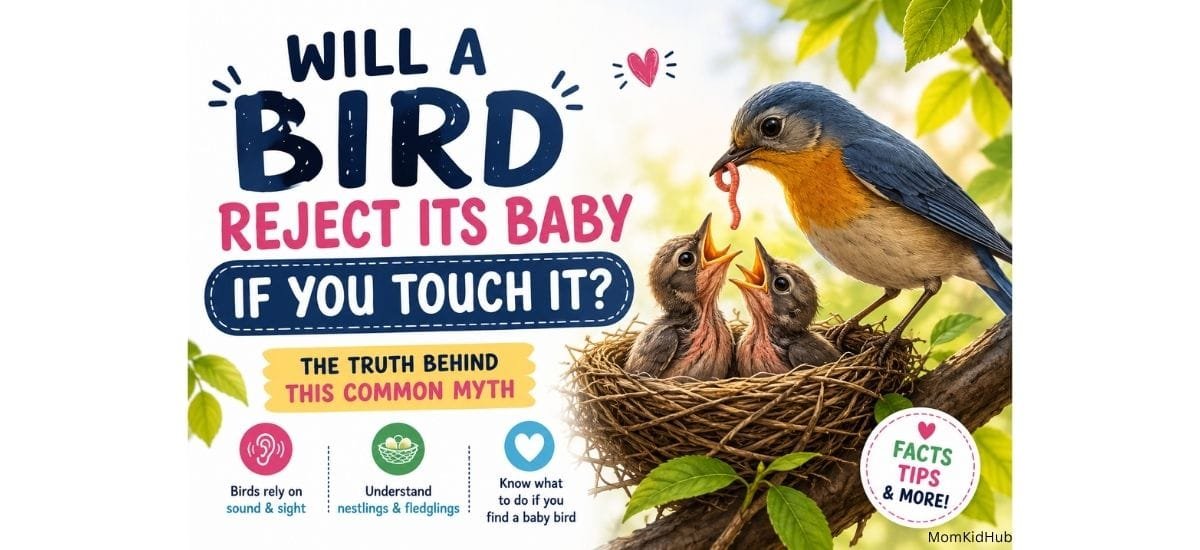
“Don’t touch that baby bird! Its mother will never come back.”
If you grew up hearing this, you’re certainly not alone.
For generations, this warning has been passed from parents to children, teachers to students, and neighbors to curious little explorers. It sounds convincing, and many of us believed it without ever questioning it.
But is it actually true?
The simple answer is no.
In most cases, a mother bird will not reject her baby simply because a human has touched it.
Surprised?
Many people are! This is one of the most common myths about birds, and understanding the truth can help us make better decisions if we ever come across a baby bird outdoors.
In this article, we’ll uncover the science behind this myth, learn how birds recognize their babies, understand what to do if you find a baby bird, and explore some amazing facts about these wonderful feathered creatures.
Let’s dive in!
Like many old sayings, this myth probably started with good intentions.
Adults wanted children to leave wildlife alone, so they warned them that touching a baby bird would cause its mother to abandon it.
The advice certainly kept curious little hands away from nests, but over time, the warning became accepted as fact.
Modern research has shown that the real story is much more interesting.
Birds don’t rely on smell the way many mammals do. Instead, they use a combination of sight, sound, instinct, and memory to care for their young.
So while it’s still important not to disturb wildlife unnecessarily, touching a baby bird is not usually the reason a parent bird would stop caring for it.
This is where the myth becomes even more interesting.
Many people assume birds have an excellent sense of smell, just like dogs or foxes.
In reality, most backyard birds rely much more on their eyesight and hearing than on their sense of smell.
When a parent bird returns to its nest, it doesn’t inspect each chick by sniffing it.
Instead, it looks for familiar sights and sounds:
These cues help parents know exactly which chicks need feeding.
Some bird species, such as vultures, kiwis, and certain seabirds, do have an impressive sense of smell. They use it to locate food over long distances. However, even these birds are not known to abandon their chicks simply because they detect human scent.
That’s why wildlife experts generally agree that a brief human touch does not make a baby bird unacceptable to its parents.
Bird parents are incredibly devoted.
Many spend weeks building nests, incubating eggs, feeding hungry chicks every few minutes, and protecting them from predators.
Instead of relying on smell, they recognize their young in several fascinating ways.
For many species, the nest itself is the biggest clue.
Parents instinctively return to the same nest over and over with food.
If their chick is there, they’ll continue feeding it.
Baby birds are surprisingly noisy.
Each chick has unique begging calls that help parents locate them, even among leaves and branches.
When a parent approaches, baby birds stretch their necks and open their bright yellow mouths as wide as they can.
This instinctive behavior signals, “I’m hungry!”
The parent immediately knows it’s feeding time.
Birds invest an enormous amount of energy raising their chicks.
After spending days or weeks caring for them, they don’t simply abandon them because of a brief human touch.
Their instinct is to keep feeding and protecting their young until they can survive on their own.
Finding a tiny bird on the ground can be heartbreaking. Your first instinct might be to pick it up and take it home. However, the best thing to do depends on the bird’s age and condition.
Before stepping in, take a moment to observe from a distance. In many cases, the parents are still nearby and caring for their young.
Let’s look at what you should do.
First, check whether the bird appears to be injured.
Signs of an injured bird include:
If you notice any of these signs, keep children and pets away and contact a local wildlife rescue organization or veterinarian as soon as possible.
This is the most important question.
Many healthy baby birds are mistaken for birds that need rescuing.
A nestling is a very young bird that:
If you find a nestling on the ground and can safely reach its nest, gently place it back.
Yes, it’s okay to do this. Its parents are very likely to continue caring for it.
If the nest has been destroyed, you can place the bird in a small container or basket lined with dry grass or tissue and secure it as close as possible to where the original nest was. Then watch from a distance to see if the parents return.
A fledgling is an older baby bird that:
Although a fledgling may look helpless, this is a perfectly normal stage of its life.
For several days, young birds leave the nest before they become strong fliers. During this time, their parents continue feeding them and keeping watch from nearby trees or rooftops.
If the bird isn’t in immediate danger, the best thing you can do is leave it where it is.
This surprises many people.
Birds don’t wait until they’re expert flyers before leaving the nest.
Instead, they leave when:
The first few days outside the nest are like “flight school.”
Young birds spend this time:
It’s a messy, clumsy, but completely natural part of growing up.
While many birds don’t need rescuing, there are situations where your help can make a real difference.
You should intervene if:
✅ The bird is clearly injured.
✅ It has been caught by a cat or dog.
✅ It is sitting in the middle of a busy road.
✅ The nest has fallen and cannot be safely replaced.
✅ Both parents have not returned for several hours (after observing quietly from a distance).
If you need to move the bird for its safety, place it in a small ventilated box lined with a soft cloth or paper towels. Keep it warm, quiet, and away from pets while you contact a wildlife rehabilitator.
Avoid giving the bird food or water unless you’ve been instructed by a wildlife expert. Different bird species have different dietary needs, and the wrong food can do more harm than good.
When we see a baby bird, it’s natural to want to help. But some well-meaning actions can actually reduce its chances of survival.
Here are a few mistakes to avoid:
❌ Taking the bird home as a pet. Wild birds need specialized care and should stay in their natural environment whenever possible.
❌ Feeding it bread or milk. Birds cannot digest milk, and bread doesn’t provide the nutrients growing chicks need.
❌ Handling it too much. Excessive handling can cause unnecessary stress.
❌ Assuming every bird on the ground has been abandoned. Many are simply fledglings learning to fly while their parents watch from nearby.
❌ Letting pets approach the bird. Even a playful cat or dog can seriously injure a young bird.
If the baby bird is fully feathered, hopping around, and doesn’t appear injured, it’s usually best to leave it alone.
If the bird is very young, featherless, or obviously injured, it may need your help or the assistance of a wildlife rescue professional.
Sometimes, the kindest thing we can do is simply give nature the space it needs to work.
Birds are some of the most incredible animals on our planet. They can fly across continents, build intricate nests, and even solve problems. Here are some amazing facts that both kids and adults will enjoy.
When we think of birds, we usually imagine them soaring through the sky. But some birds spend their entire lives on the ground.
Examples include:
Penguins, for instance, can’t fly through the air—but they are exceptional swimmers, using their wings like flippers to glide underwater.
Birds have lightweight, hollow bones that help reduce their body weight, making flight easier. Even though these bones are hollow, they’re strengthened with tiny internal supports, making them surprisingly strong.
Many birds migrate to escape cold weather or to find food.
The Arctic Tern holds the record for the longest migration of any bird, travelling around 70,000 kilometres (43,000 miles) every year between the Arctic and Antarctica. That’s like flying around the Earth almost twice!
Every bird species builds its nest differently.
Some weave grass into hanging baskets, others use mud, sticks, feathers, moss, or even spider silk. The tiny weaver bird is especially famous for creating beautifully woven nests that hang from tree branches.
Many baby birds hatch almost naked and completely dependent on their parents.
Within just a few weeks, they grow feathers, learn to hop, stretch their wings, and take their very first flight—a remarkable transformation in such a short time.
Birds don’t just sing beautiful songs.
They also communicate through:
Some birds even have different alarm calls to warn others about nearby predators.
Crows are considered among the smartest birds in the world.
Scientists have observed them:
Their problem-solving abilities are often compared to those of young children.
Owls cannot rotate their heads a full 360 degrees, but they can turn them about 270 degrees.
This incredible ability helps them look around without moving their bodies, making them excellent nighttime hunters.
Have you ever seen a bird carefully running its beak through its feathers?
This behaviour is called preening.
During preening, birds:
It’s an important part of staying healthy.
Many bird parents work together to raise their chicks.
They take turns:
Watching parent birds care for their babies reminds us just how devoted they are.
Let’s separate fact from fiction.
Truth: In most cases, this isn’t true. Parent birds usually continue caring for their chicks because they rely on sight, sound, and instinct rather than human scent.
Truth: Many are healthy fledglings learning to fly while their parents watch from nearby.
Truth: Different birds have different diets. Some eat seeds, fruits, nectar, insects, fish, or even small animals.
Truth: Birds sleep every day. Some even sleep standing on one leg or perched on branches without falling off.
Truth: Simply observing a nest from a respectful distance will not usually cause parents to abandon it. However, getting too close repeatedly may stress the birds or attract predators, so it’s always best to admire nests without disturbing them.
Truth: Birds do not drink milk like mammals. Giving milk to a wild bird can make it very sick.
Truth: Some birds nest on cliffs, in burrows, on the ground, inside tree holes, or even on buildings.
Truth: Many birds have impressive memories, can solve problems, recognize patterns, and even learn from one another. Some species use tools and adapt their behavior to new challenges.
No. This is one of the most common myths about birds. Most birds do not recognize their chicks by human scent. Instead, they identify them by their calls, appearance, and the location of the nest. If a baby bird has been gently handled and returned to its nest, the parents will usually continue caring for it.
Yes. If the bird is a nestling (very young, with few feathers) and you can safely reach the nest, it’s generally safe to place it back. Contrary to popular belief, the parents are unlikely to reject it because it has been touched.
First, observe the bird from a distance.
If it’s fully feathered and hopping around, it’s probably a fledgling learning to fly. Leave it alone unless it’s in immediate danger.
If it’s very young, injured, or has no feathers, it may need help. If possible, return it to its nest or contact a licensed wildlife rehabilitator.
Some birds have an excellent sense of smell, but most garden and backyard birds rely much more on their eyesight and hearing. Human scent alone usually doesn’t cause parent birds to abandon their chicks.
Young birds leave the nest during the fledgling stage, when they’re strong enough to hop, flap, and practice short flights. Their parents continue feeding and protecting them while they learn these important survival skills.
No. Baby birds have very specific dietary needs that vary from one species to another. Giving them bread, milk, or other household foods can be harmful. If a bird truly needs rescue, keep it warm and safe while contacting a wildlife rehabilitation expert.
Nature has an incredible way of looking after its young.
A tiny bird on the ground may seem helpless, but in many cases, its parents are close by—watching carefully, bringing food, and encouraging it to take its very first flights.
The next time you hear someone say, “Don’t touch the baby bird or its mother will never come back,” you’ll know the truth.
While it’s always best to avoid handling wild animals unless necessary, a brief human touch is not what causes most parent birds to abandon their chicks.
The best thing we can do is observe with patience, respect wildlife, and step in only when a bird is injured or truly in danger.
Sometimes, the greatest way to help nature is simply to let nature do its job.
Every day, the world around us is full of fascinating questions waiting to be answered.
Why do birds sing in the morning?
How do ants always find their way home?
Why is an octopus’s blood blue?
How do butterflies remember where to fly?
At MomKidHub, we love turning everyday questions into fun learning adventures for curious kids and families.
If your little one enjoys discovering amazing facts about animals, science, and nature, don’t forget to explore more articles on our blog. Learning becomes even more exciting when we stop asking “What?” and start asking “Why?”
Happy exploring! 🐦🌿