

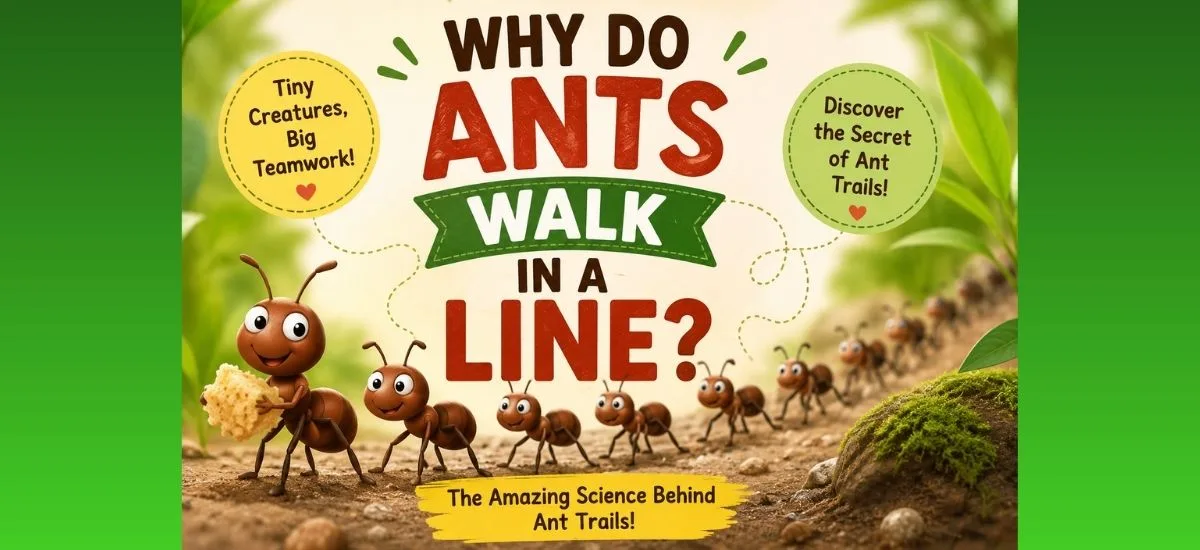
Have you ever seen a long line of ants marching across the floor or through your garden?
One tiny ant goes first, and many others follow behind in a perfect line. It almost looks like they’re following an invisible road!
But have you ever wondered why do ants walk in a line? Do they have a leader? Are they talking to each other? Or are they simply copying the ant in front?
Let’s discover the fascinating science behind these tiny teamwork experts!
The simple answer is:
Ants walk in a line because they follow a special scent trail called a pheromone trail.
A pheromone is a natural chemical that ants use to communicate with each other. Humans mostly communicate by speaking, but ants “talk” using smells.
When an ant finds food, it walks back to its nest while leaving behind a trail of pheromones.
Other ants smell this invisible trail with their antennae and follow it to the food source.
That’s why they seem to walk in a neat line.
A pheromone is a special chemical message.
Think of it like drawing arrows on the ground for your friends to follow.
Instead of using paint or chalk, ants leave behind tiny drops of scent that only other ants can smell.
These invisible scent trails help ants:
Amazing, isn’t it?
Not every ant knows where food is.
Some ants are called scout ants.
Scout ants leave the nest and search in different directions until one discovers food.
Once a scout ant finds something tasty, it rushes back to the nest while laying a pheromone trail.
Soon, dozens or even hundreds of ants follow the same path to collect the food together.
Many people think there is one ant leading the others.
The answer is no.
There isn’t a traffic police ant or a captain ant telling everyone where to go.
Each ant simply follows the strongest pheromone trail it can smell.
This is called collective behavior, where every ant follows simple rules, but together they achieve amazing teamwork.
Ants have two antennae that act like tiny noses.
These antennae help them:
Because their sense of smell is so powerful, ants can stay on the correct path even when we cannot see the trail.
Every ant that follows the trail adds a little more pheromone.
This makes the scent stronger.
A stronger trail attracts even more ants.
This creates a busy ant highway!
The best path becomes the strongest one because many ants keep using it.
Sometimes rain, wind, or people cleaning the floor can remove the pheromone trail.
Without the scent, ants become confused.
You may notice them walking in circles or moving randomly.
Soon, one ant finds the trail again or creates a new one.
The rest of the ants quickly follow the new path.
Yes!
One of the most amazing facts about ants is their incredible strength.
Many ants can carry 10 to 50 times their own body weight.
Imagine carrying a car on your back!
That’s why you often see several ants working together to move a large crumb or insect.
An ant alone cannot do much.
But thousands of ants working together can:
Their teamwork is one reason ants are among the most successful insects on Earth.
🐜 There are over 12,000 known species of ants worldwide.
🐜 Ants have lived on Earth for more than 100 million years.
🐜 Some ant colonies have millions of ants.
🐜 Ants don’t have lungs. They breathe through tiny holes in their bodies.
🐜 Ants can communicate using smells, touch, and vibrations.
You’ll need:
Remember to observe the ants without disturbing them.
Scientists have discovered that ants often find the shortest route to food.
Here’s why:
Imagine there are two paths.
The ants using the shorter path return faster.
Because they return sooner, they leave more pheromones.
The stronger scent attracts even more ants.
Eventually, almost every ant follows the shortest route.
Without any leader, the colony naturally chooses the best path.
Nature is amazing!
A) They hold hands.
B) They follow pheromone trails.
C) They copy the biggest ant.
✅ Answer: B
A) Worker ants
B) Scout ants
C) Queen ants
✅ Answer: B
Ants use their antennae to smell.
✅ Answer: True
There is one ant leader giving directions.
❌ Answer: False
Scientists sometimes study ant colonies to design better computer networks, robot teams, and delivery routes because ants are excellent at finding efficient paths.
Tiny insects are helping solve big human problems!
So, why do ants walk in a line?
They follow invisible pheromone trails left by other ants.
These scent trails help ants find food, return to their nest, communicate with one another, and work together as a team.
The next time you spot a line of ants, you’ll know they’re not just walking randomly—they’re following nature’s invisible road!
Ants follow invisible pheromone trails left by other ants, which guide them to food and back to their nest.
Yes. Ants communicate using pheromones, touching antennae, and vibrations.
No. Scout ants often explore alone. Once food is found, many ants follow the pheromone trail in a line.
If the pheromone trail fades, is washed away, or gets blocked, ants may become confused until they create a new trail.
No. Ant colonies work without a leader directing traffic. Each ant follows simple rules, and together they create organized behavior.
The tiny ants we often ignore are actually brilliant problem-solvers. Their ability to communicate, cooperate, and find the shortest path without a leader is one of nature’s greatest wonders. Next time you see ants marching in a line, take a closer look—you’ll be watching teamwork, science, and survival in action!
Continue the learning adventure with more fun and educational articles:
Happy learning with MomKidHub! ❤️