
Some days feel so long when you’re stuck indoors with kids.
Maybe it’s too hot outside. Maybe it’s raining. Maybe someone is unwell. Or maybe you just need a simple, low-energy day at home. And before you know it, your toddler is bored, your preschooler is asking for the tablet, and you’re running out of ideas.
I’ve been there too — more times than I can count.
The good news? You don’t need fancy toys or expensive kits. In fact, most indoor activities for kids use simple things you already have at home. That’s what makes them so easy to try.
In this post, I’m sharing 50 easy indoor activities for kids that are:
These indoor activities for toddlers and preschoolers are perfect for home days, rainy afternoons, or when you need screen-free play ideas.
Some of these are quick 5-minute games. Some can keep your child busy for 30 minutes or more. Many of them build fine motor skills, coordination, and creativity. And the best part? It doesn’t feel like “work” at all.
You don’t have to try all 50 in one week. Just bookmark this page and come back whenever you need a fresh idea.
Looking for seasonal ideas too? You may also enjoy our simple seasonal activities for kids throughout the year.
Let’s start with the easiest ones — no-prep indoor activities you can set up in minutes.
💛 Want a printable version of this list?

Scroll down to grab the free checklist you can print and keep handy.
What you need:
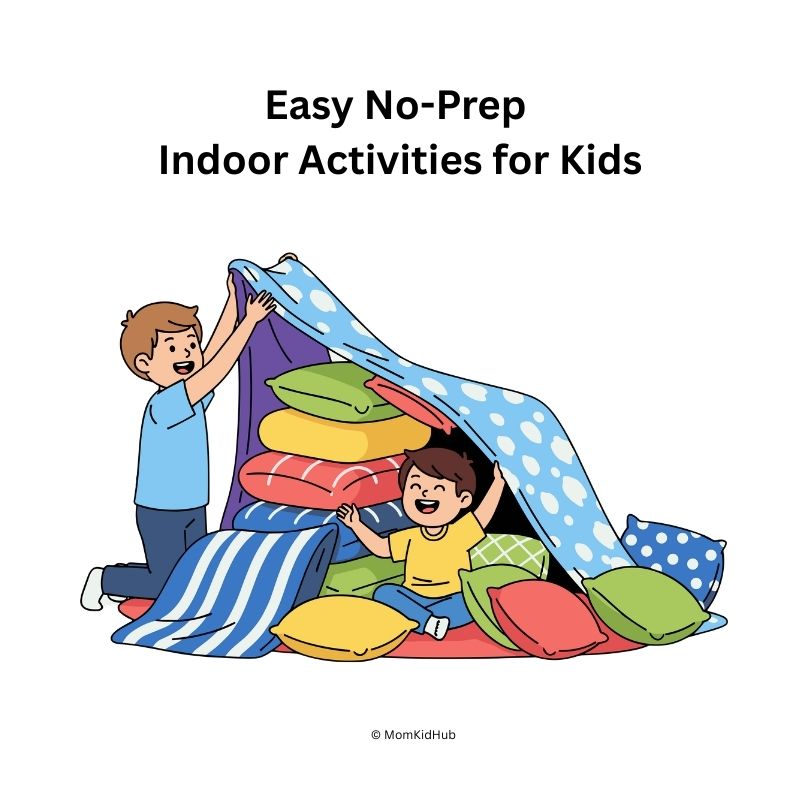
Pillows, cushions, blankets
How to do it:
Lay pillows on the floor and create a simple path. Ask your child to jump from pillow to pillow, crawl under a blanket “tunnel,” or balance along a line of cushions.
Why it’s great:
This activity builds gross motor skills, balance, and coordination.
Best for age:
2–6 years
What you need:
1 balloon
How to do it:
Blow up a balloon and challenge your child to keep it in the air without letting it touch the ground. You can count how many taps they manage.
Why it’s great:
At the same time, it improves hand-eye coordination and keeps kids active indoors.
Best for age:
3–6 years
What you need:
Nothing!
How to do it:
Take turns hiding around the house while the other person counts. For younger toddlers, you can hide a favorite toy instead.
Why it’s great:
Encourages problem-solving and spatial awareness.
Best for age:
2–6 years
What you need:
Any sticker sheet + paper
How to do it:
Give your child stickers and let them peel and stick freely on paper. You can also draw simple shapes and ask them to decorate inside.
Why it’s great:
Strengthens fine motor muscles needed for writing.
Best for age:
2–5 years
What you need:
Painter’s tape or masking tape
How to do it:
Stick tape in a straight line or zig-zag pattern on the floor. Ask your child to walk along the line like a balance beam.
Why it’s great:
Builds balance, coordination, and focus.
Best for age:
3–6 years
What you need:
Nothing (optional: small basket)
How to do it:
Call out a color and ask your child to find objects in that color around the house. Make it a race or a timed challenge.
Why it’s great:
Supports color recognition and observation skills.
Best for age:
2–5 years
What you need:
Music
How to do it:
Play music and let your child dance. When the music stops, they must freeze like a statue.
Why it’s great:
Improves listening skills and self-control.
Best for age:
3–6 years
What you need:
Flashlight or lamp
How to do it:
Turn off the lights and use a flashlight to create shadows on the wall. Make animal shapes with your hands or let your child experiment.
Why it’s great:
Encourages imagination and curiosity about light and shadows.
Best for age:
3–7 years
What you need:
Laundry basket + soft balls or socks
How to do it:
Place a laundry basket a few feet away and let your child throw rolled-up socks into it. Move the basket farther for more challenge.
Why it’s great:
Builds coordination and aim.
Best for age:
3–6 years
What you need:
Nothing
How to do it:
Start a story with one sentence: “Once upon a time there was a little dinosaur…” Then take turns adding one sentence at a time.
Why it’s great:
Boosts creativity, vocabulary, and confidence.
Best for age:
4–7 years
What you need:
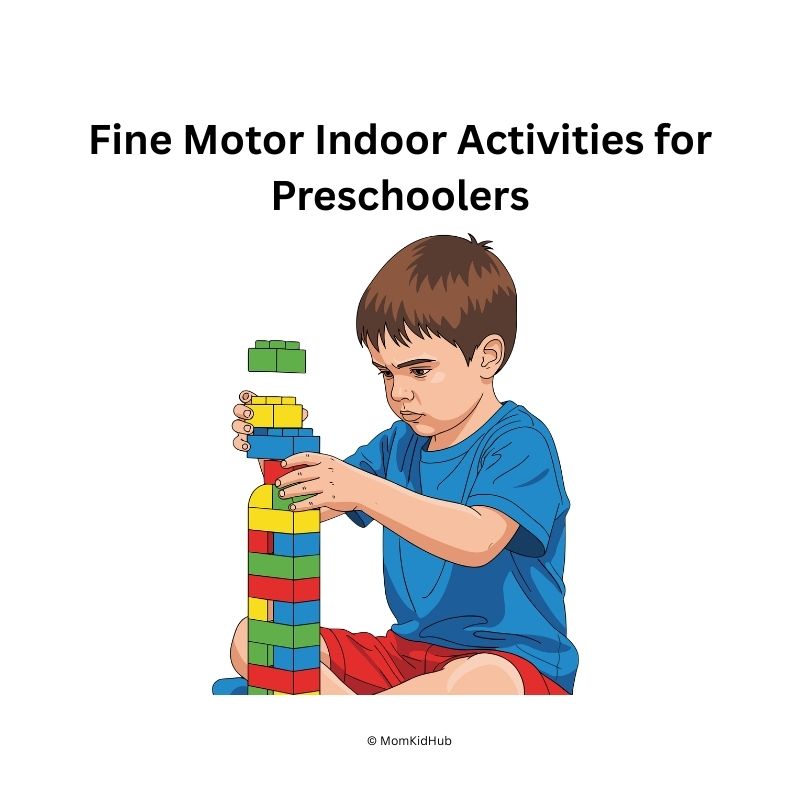
Pom poms + 2 bowls + spoon
How to do it:
Place pom poms in one bowl and ask your child to transfer them to another bowl using only a spoon. For younger toddlers, you can let them use their hands first.
Why it’s great:
Strengthens hand muscles and improves coordination.
Best for age:
2–5 years
What you need:
Clothespins + colored paper
How to do it:
Stick colored paper strips on cardboard and ask your child to clip matching clothespins onto each color.
Why it’s great:
Builds finger strength needed for writing and cutting.
Best for age:
3–6 years
What you need:
Large beads + string or shoelace
How to do it:
Let your child thread beads freely or follow a simple color pattern.
Why it’s great:
Improves concentration and hand-eye coordination.
Best for age:
3–6 years
What you need:
Old magazines or colored paper + glue
How to do it:
Ask your child to tear paper into small pieces and glue them to create a collage.
Why it’s great:
Strengthens fine motor muscles and bilateral coordination.
Best for age:
2–5 years
What you need:
Dot stickers + paper
How to do it:
Draw simple lines or shapes and ask your child to place stickers along the lines.
Why it’s great:
Prepares little hands for pre-writing skills.
Best for age:
3–5 years
What you need:
Child-safe tweezers + small objects (beans, pom poms)
How to do it:
Place small items in a bowl and ask your child to transfer them using tweezers.
Why it’s great:
Develops pencil grip strength.
Best for age:
3–6 years
What you need:
Coins + small container with slit lid
How to do it:
Cut a slit in a box lid and let your child drop coins through the opening.
Why it’s great:
Enhances hand control and precision.
Best for age:
2–4 years
What you need:
Playdough
How to do it:
Encourage your child to roll snakes, pinch tiny balls, flatten shapes, or use cookie cutters.
Why it’s great:
Strengthens small hand muscles for writing readiness.
Best for age:
2–6 years
What you need:
Mixed buttons + small bowls
How to do it:
Ask your child to sort buttons by color or size. (Always supervise younger kids.)
Why it’s great:
Builds focus and classification skills.
Best for age:
3–6 years
What you need:
Cotton swabs + paint + paper
How to do it:
Let your child dip Q-tips in paint and create dots, patterns, or fill shapes.
Why it’s great:
Improves hand control and creativity.
Best for age:
2–5 years
If you want more focused ideas, check out our complete guide to fine motor activities for preschoolers.
Meanwhile, sensory play is another powerful way to support development indoors.
What you need:
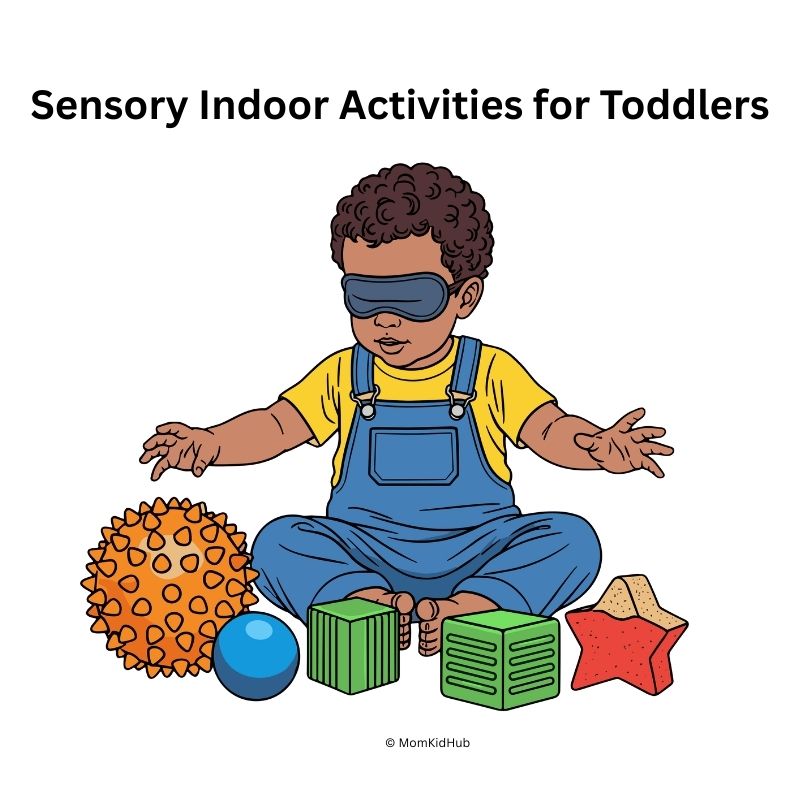
Rice + container + small cups or spoons
How to do it:
Fill a large container with rice and add scoops, cups, or small toys. Let your child pour, scoop, and explore freely.
Why it’s great:
Supports sensory processing and fine motor skills.
Best for age:
2–5 years
What you need:
Dyed rice (optional food coloring) + container
How to do it:
Color rice using a few drops of food coloring and let it dry. Add small toys or letters for a themed sensory experience.
Why it’s great:
Encourages imaginative play and sensory exploration.
Best for age:
3–6 years
What you need:
Bowls + cups + water + towel underneath
How to do it:
Set up a simple pouring station and let your child transfer water from one container to another.
Why it’s great:
Builds coordination and concentration.
Best for age:
2–5 years
What you need:
Frozen toys in ice + bowl + warm water
How to do it:
Freeze small toys inside ice cubes. Give your child warm water and droppers to “rescue” the toys.
Why it’s great:
Teaches patience and basic science concepts.
Best for age:
3–6 years
What you need:
Dish soap + water + whisk
How to do it:
Whisk dish soap and water to create fluffy foam. Let your child explore with spoons and small cups.
Why it’s great:
Provides calming sensory input.
Best for age:
2–5 years
What you need:
Dry pasta + bowls + scoops
How to do it:
Place different types of pasta in a bin and allow your child to scoop, sort, and pour.
Why it’s great:
Enhances tactile awareness and sorting skills.
Best for age:
2–5 years
What you need:
Kinetic sand + tray + small molds
How to do it:
Let your child squeeze, mold, and shape kinetic sand using cookie cutters or small cups.
Why it’s great:
Strengthens hand muscles and encourages creativity.
Best for age:
3–6 years
What you need:
Bin filled with rice or beans + hidden small toys
How to do it:
Hide small objects inside a sensory bin and ask your child to find them.
Why it’s great:
Improves focus and problem-solving skills.
Best for age:
3–6 years
What you need:
Bubble wrap
How to do it:
Spread bubble wrap on the floor and let your child stomp, jump, and pop.
Why it’s great:
Provides sensory input and gross motor movement indoors.
Best for age:
3–6 years
What you need:
Oats + spoons + small cups
How to do it:
Fill a container with oats and let your child scoop, pour, and pretend cook.
Why it’s great:
Encourages imaginative and tactile play.
Best for age:
2–5 years
In addition to sensory fun, you can also introduce simple STEM learning at home.
What you need:
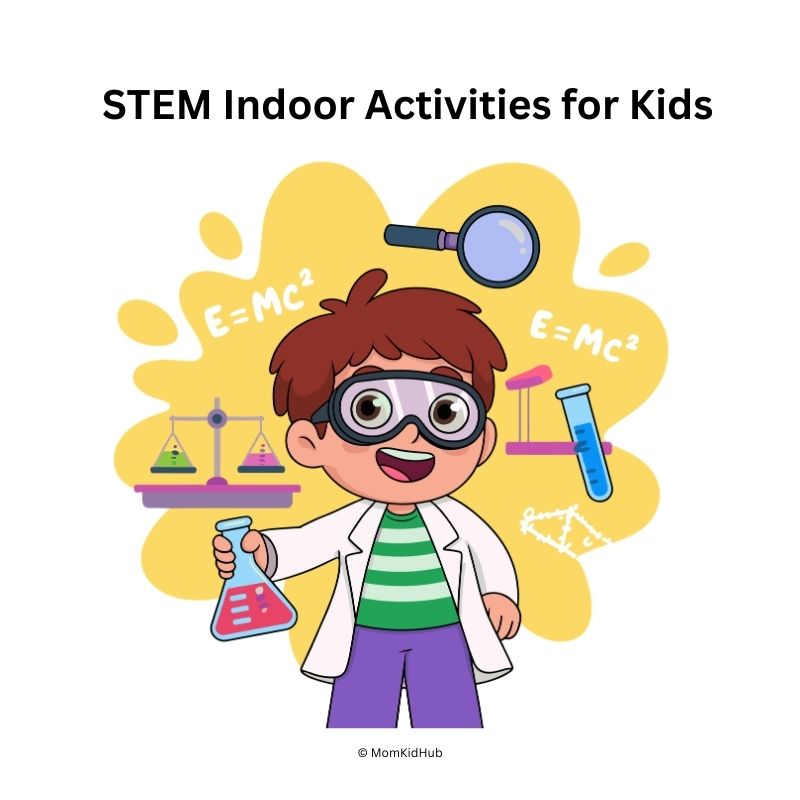
Clear cups + water + food coloring
How to do it:
Fill three cups with water. Add red, blue, and yellow food coloring separately. Let your child mix two colors together to discover new colors.
Why it’s great:
Introduces basic science concepts and color theory.
Best for age:
3–6 years
What you need:
Bowl of water + small household objects
How to do it:
Ask your child to guess whether an object will sink or float before placing it in water.
Why it’s great:
Encourages prediction skills and scientific thinking.
Best for age:
3–6 years
What you need:
Colored candies + plate + warm water
How to do it:
Arrange candies in a circle on a plate. Pour warm water in the center and watch the colors spread.
Why it’s great:
Teaches observation and cause-and-effect.
Best for age:
3–6 years
What you need:
Flashlight + small toy
How to do it:
Shine a flashlight on a toy and move it closer and farther to observe how the shadow changes.
Why it’s great:
Introduces light and shadow concepts.
Best for age:
4–7 years
What you need:
Measuring cups + bowl + water
How to do it:
Let your child pour water into different measuring cups and compare quantities.
Why it’s great:
Builds early math skills and understanding of volume.
Best for age:
3–6 years
What you need:
Child-safe magnets + metal and non-metal objects
How to do it:
Let your child test which objects stick to magnets and which do not.
Why it’s great:
Introduces basic physics concepts.
Best for age:
4–7 years
What you need:
Building blocks or LEGO
How to do it:
Create a simple color pattern and ask your child to continue it.
Why it’s great:
Strengthens logical thinking and early math skills.
Best for age:
3–6 years
What you need:
Paper + crayons
How to do it:
Draw a simple chart and track daily weather together for a week.
Why it’s great:
Encourages observation and early data recording.
Best for age:
4–7 years
What you need:
Cardboard + small toy cars
How to do it:
Create a simple ramp and test how fast cars roll from different heights.
Why it’s great:
Introduces speed and gravity concepts.
Best for age:
3–7 years
What you need:
Buttons, spoons, blocks, or fruits
How to do it:
Ask your child to count, group, or sort objects into small sets.
Why it’s great:
Builds early number sense and classification skills.
Best for age:
2–5 years
Explore more simple STEM activities for preschoolers here.
What you need:
Paper + paint + tray + marbles
How to do it:
Place paper inside a tray, add a few drops of paint, and roll marbles around to create abstract art.
Why it’s great:
Encourages creativity while strengthening hand control.
Best for age:
3–6 years
What you need:
Painter’s tape + paper + paint or crayons
How to do it:
Create patterns on paper using tape. Let your child color or paint over it, then peel off the tape to reveal designs.
Why it’s great:
Builds patience and fine motor skills.
Best for age:
3–7 years
What you need:
Dot markers + paper
How to do it:
Let your child create patterns, fill shapes, or design pictures using dot markers.
Why it’s great:
Strengthens hand coordination and color recognition.
Best for age:
2–5 years
What you need:
Paper plates + crayons + glue + elastic/string
How to do it:
Decorate paper plates to create animal or superhero masks.
Why it’s great:
Encourages imaginative play and creativity.
Best for age:
3–7 years
What you need:
Old cardboard box + markers
How to do it:
Turn a box into a car, house, rocket, or shop using simple drawings and cut-outs.
Why it’s great:
Boosts open-ended thinking and problem-solving.
Best for age:
3–7 years
What you need:
Washable paint + paper
How to do it:
Dip hands in paint and press onto paper. Turn the prints into animals or trees.
Why it’s great:
Sensory-rich and memory-making activity.
Best for age:
2–6 years
What you need:
Toilet paper rolls, bottle caps, scrap paper, glue
How to do it:
Create a “craft box” from recyclables and let your child build freely.
Why it’s great:
Encourages creativity and resourcefulness.
Best for age:
3–7 years
What you need:
Old magazines + glue + paper
How to do it:
Cut or tear pictures and glue them to create themed collages (animals, food, colors).
Why it’s great:
Builds fine motor and decision-making skills.
Best for age:
3–6 years
What you need:
Washable markers
How to do it:
Let your child draw on windows or mirrors, then wipe clean later.
Why it’s great:
Makes indoor art exciting and different.
Best for age:
3–6 years
What you need:
Potatoes or sponge pieces + paint
How to do it:
Cut simple shapes into potatoes or sponges and dip them in paint to stamp patterns.
Why it’s great:
Improves creativity and motor control.
Best for age:
3–7 years
We also share easy art activities for toddlers here.
Affiliate Disclosure!
This post may contain affiliate links. As an Amazon Associate, I earn from qualifying purchases at no extra cost to you.
You absolutely don’t need expensive toys to try these indoor activities. In fact, most of them can be done with things you already have at home.
However, keeping a few basic tools handy can make setup quicker — especially on busy days.
Here are a few supplies we personally use and love:
These are the tools we personally use at home — they make setup quicker and indoor play more enjoyable.
👉 You can find all of these in our curated Indoor Activity Supplies list here:
Some days you just need a quick idea without scrolling.
Download this simple printable checklist with all 50 indoor activities and keep it on your fridge for easy inspiration.
Get your free copy below:
❓ Frequently Asked Questions About Indoor Activities for Kids
Simple activities like sticker play, water pouring, rice sensory bins, and pillow obstacle courses work wonderfully for toddlers.
Offer a mix of movement activities, sensory play, and creative art projects. Rotating activities every few days keeps things exciting.
Balloon games, storytelling, sensory bins, building blocks, and simple science experiments are great screen-free options.
For toddlers, 5–15 minutes is perfect. Preschoolers may stay engaged for 20–40 minutes depending on interest.
Yes! Many indoor play ideas support fine motor skills, problem-solving, coordination, and creativity.
These indoor activities for kids are simple to set up, fun to try, and easy to repeat whenever you need screen-free play at home.
So the next time you feel stuck indoors, come back to this list and try one simple idea. Sometimes, one small activity is all it takes to turn the whole day around.
You don’t have to do everything. Just start with one.
Looking for more activities that build focus, creativity, and thinking skills? Our kids activity worksheets pack includes engaging printables perfect for home learning.